


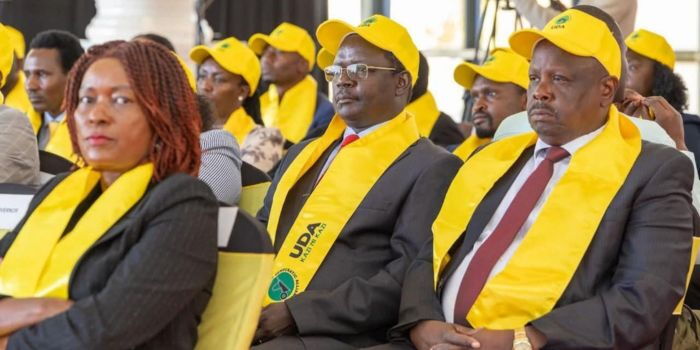
Outrage as JSC Vice Chairperson Isaac Ruto Attends UDA Political Event at State House
Judicial Service Commission (JSC) Vice Chairperson Isaac Ruto is facing growing pressure to resign after he was spotted attending a United Democratic Alliance (UDA) political event at State House while openly wearing party-branded merchandise linked to President William Ruto.
The incident has sparked public outrage and raised serious concerns about the independence and neutrality of the Judiciary.
In a strongly worded letter dated January 27 and addressed to Chief Justice Martha Koome, former JSC Vice Chairperson Macharia Njeru accused Isaac Ruto of violating the Constitution by engaging in active politics while still holding office.
Njeru argued that by publicly associating with UDA, Ruto had compromised the integrity of his role and undermined the constitutional mandate of the Judicial Service Commission.
Njeru stated that any form of political involvement by a serving JSC commissioner goes against established laws and ethical standards.
He cited the Constitution, the Leadership and Integrity Act, and the Judicial Service Code of Conduct, all of which require commissioners to remain politically neutral.
According to him, such conduct poses a serious threat to the independence of the Judiciary, which must remain free from political influence to maintain public trust.
“It is unheard of for a JSC commissioner to openly align himself with a political party or participate in partisan political activities while still in office,” Njeru said.
He added that such behavior directly contradicts the clear provisions of the law and sets a dangerous precedent that could weaken the Judiciary’s credibility and autonomy.
Drawing from his own experience, Njeru noted that during his time at the commission, involvement in active politics was one of the automatic grounds for disqualifying candidates seeking judicial positions.
This rule, he explained, was designed to protect the Judiciary from being dragged into partisan political battles. He questioned how the same standards could now be ignored when a senior commissioner appears to be doing what is clearly discouraged.
“To have a serving commissioner, and one who is also the Vice Chairperson, engaging in conduct that is openly frowned upon is unacceptable,” Njeru wrote.
He said he felt morally and professionally obligated to raise the matter directly with the commission through the Chief Justice.
In his letter, Njeru made two key demands. First, he called on Isaac Ruto to immediately recuse himself from all ongoing interviews for judicial positions, arguing that his perceived political alignment could compromise the fairness of the process.
Secondly, he urged Ruto to resign from the Judicial Service Commission altogether to protect the integrity and credibility of the institution.
“My expectation is that Hon. Ruto will step aside from participating in the remaining judge interviews and proceed to resign from the commission with immediate effect, for the greater good of our Judiciary and the JSC,” Njeru stated.
The letter came shortly after the Consumer Federation of Kenya (COFEK) also petitioned the commission over the same issue. COFEK raised concerns after Isaac Ruto was seen attending the UDA National Governing Council (NGC) meeting at State House.
The consumer lobby group argued that attending such partisan political gatherings violates the constitutional requirement for political neutrality among state officers serving in sensitive positions.
Isaac Ruto is a seasoned politician who previously served as the Governor of Bomet County before his appointment to the Judicial Service Commission in 2023. Prior to joining the commission, he was the leader of the Chama Cha Mashinani (CCM) Party.
The party later voluntarily dissolved and merged with UDA, further fueling concerns about his continued political affiliations.
Under the Judicial Service Act of 2011, JSC commissioners are expressly barred from engaging in partisan politics. The law aims to safeguard judicial independence and maintain public confidence in the justice system. It also requires any person appointed to the commission to relinquish any elective political office they may hold.
As pressure mounts, the controversy has reignited debate on the boundaries between politics and the Judiciary, with many observers warning that failure to uphold strict neutrality could have long-term consequences for Kenya’s justice system.
Join Tutam Official WhatsApp Channel to stay updated on time
https://whatsapp.com/channel/0029VaWT5gSGufImU8R0DO30
