


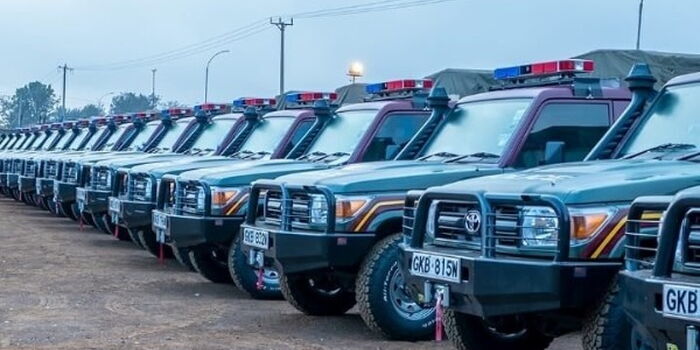
Police officers across the country are expected to gain better transport support as the government rolls out major reforms, including a possible shift to electric vehicles.
President William Ruto revealed the plans on Tuesday, 2 December, while presenting the Jukwaa la Usalama report at State House, Nairobi. He noted that officers have repeatedly complained about constant fuel shortages, which have slowed down their daily operations and weakened response efforts.
President Ruto announced that the government will now increase its initial plan of buying 1,200 police vehicles to 3,000 units, saying the goal is to significantly boost mobility and ensure officers can respond to incidents without unnecessary delays.
“We already have a budget for 1,200 vehicles, but we want to acquire 3,000 police vehicles so that movement is improved,” Ruto said. “We are also working on a plan to ensure these vehicles always have fuel so that officers can carry out their duties without being interrupted.”
For years, officers have raised concerns about the use of petrol-powered vehicles, despite the earlier success of the Motor Vehicle Leasing program.
According to Interior Cabinet Secretary Kipchumba Murkomen, the current monthly fuel allocation of 450 litres per vehicle is not enough—especially for officers working in remote rural stations and those in busy urban centers where the workload is heavy and constant.
The report also highlighted another major issue: slow repairs and maintenance. Long delays at garages have often left officers without vehicles, disrupting law enforcement and emergency response.
To address these challenges, President Ruto said the government is now preparing to introduce electric vehicles (EVs) into the police fleet.
He explained that EVs would make operations easier and cheaper since officers would simply need to charge the vehicles overnight before resuming duty.
“We already have electric vehicles in the country, and we are going back to electric. This way, an officer can charge the vehicle in the evening and get back to work efficiently,” he added.
Additional Police Reforms
Beyond transport improvements, the President also announced several new reforms aimed at strengthening police services nationwide.
- Construction of 900 Police Stations:
The government plans to build 900 new police stations within the next two years. This will be achieved by using multiple government programs: 300 stations funded through NG-CDF, another 300 built through the housing program, and the final 300 constructed by the Interior Ministry. - Promotions for All Police Officers:
President Ruto further stated that every police officer will be promoted by at least one rank by June 1, 2026. This includes officers who are 50 years old and still serving in the constable rank, ensuring long-serving officers receive recognition for their service. - Digitising Police Records:
The government also plans to modernise police operations by digitising all records, including OB entries. As part of this digital shift, every chief across the country will receive a tablet to help them file reports directly on an online platform, improving transparency and efficiency.
These reforms signal a major effort by the government to improve policing in Kenya, enhance officer welfare, and make law enforcement more responsive, modern, and technology-driven.
Join Gen z Official WhatsApp Channel to share your thoughts and stay updated on time
https://whatsapp.com/channel/0029VaWT5gSGufImU8R0DO30
