


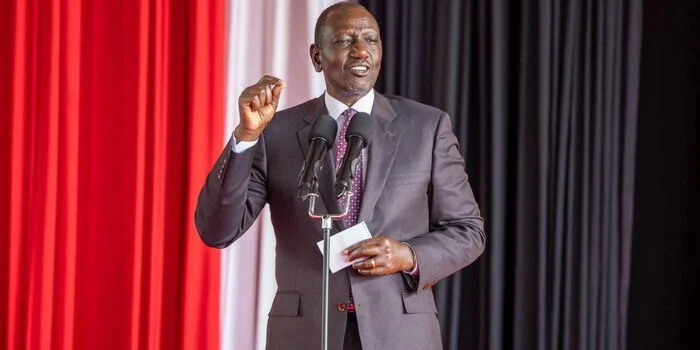
Ruto Assures CJ Koome of 228 New Judicial Officers to Be Hired by March 2026
President William Ruto has announced a major recruitment drive aimed at strengthening Kenya’s judiciary, promising the hiring of 228 new judicial officers by March 2026.
The planned recruitment includes 60 High Court judges and 168 resident magistrates, a move intended to reduce the growing backlog of court cases and improve access to justice across the country.
The President made the announcement while presiding over the swearing-in ceremony of 15 new Court of Appeal judges at State House.
He said the new appointments form part of a wider government strategy to expand judicial capacity and ensure courts operate more efficiently and fairly.
President Ruto noted that his administration has consistently invested in strengthening the judiciary, particularly by improving its human resource capacity.
He emphasized that a strong judiciary requires not just independence, but also enough skilled personnel and institutional depth to carry out its constitutional mandate effectively.
“In the High Court alone, we will have appointed a total of 60 new judges by March this year,” the President said, adding that the government remains committed to ensuring the judiciary has the manpower needed to serve Kenyans promptly and professionally.
The recruitment of High Court judges is being conducted in stages. Twenty judges were appointed in December 2022, followed by another 20 in May 2024.
The final phase, which will add the remaining 20 judges, is expected to begin on February 4, 2026, through a competitive and transparent selection process overseen by the Judicial Service Commission (JSC).
In addition to the High Court appointments, President Ruto confirmed that the JSC has already recruited 168 resident magistrates, a move that is expected to significantly improve service delivery in magistrates’ courts.
These lower courts handle the majority of criminal and civil cases and are often the most congested within the judicial system.
The President highlighted the pressure currently facing the courts, revealing that as of December 2025, the Court of Appeal had a backlog of about 14,300 cases, with a case clearance rate of 68 percent.
He said these figures clearly show the urgent need to increase judicial staff in order to match the rising number of cases being filed each year.
“These appointments are being made where the need is greatest, and they are already helping to ease pressure across the entire judicial system,” President Ruto said.
Beyond recruitment, the President emphasized that the government has also increased financial support to the judiciary.
He noted that the judiciary’s budget allocation rose from Sh18.8 billion in 2023 to Sh21.8 billion in 2024, allowing for improved staffing, better infrastructure, and smoother court operations nationwide.
As of January 2026, the Judiciary has rolled out several long-term strategies to address case backlogs and delays. In December 2025, an additional 100 resident magistrates were appointed to strengthen subordinate courts, which handle the bulk of unresolved criminal and civil matters.
The Judiciary has also embraced digital reforms to improve efficiency. Courts are gradually moving away from paper-based systems to fully integrated digital platforms.
The introduction of nationwide e-filing has helped reduce file losses, cut down administrative delays, and improve record management.
Through the Mahakama Popote initiative, judicial officers can now hear cases remotely, allowing workloads to be shared across different regions, especially from high-volume courts.
The Judiciary has also introduced AI-powered transcription technology, which has improved the speed and accuracy of recording court proceedings.
Specialized court models have further improved case resolution. Small Claims Courts, which handle civil and commercial disputes below Sh1 million, recorded an impressive 98 percent case clearance rate during the 2024/25 financial year.
The Judiciary also conducts themed “Service Weeks”, where older and long-pending cases are prioritized for quick resolution.
To bring justice closer to the people, 57 mobile courts have been deployed across the country, helping to reduce travel distances and costs for citizens in remote areas.
At the same time, alternative dispute resolution mechanisms have been expanded through Court-Annexed Mediation and eight Alternative Justice System suites, which incorporate community-based and traditional methods of resolving disputes before they reach formal courts.
Together, these reforms and recruitment efforts are aimed at building a stronger, faster, and more accessible judicial system—one that delivers justice efficiently, reduces delays, and restores public confidence in Kenya’s courts.
Join Tutam Official WhatsApp Channel to stay updated on time
https://whatsapp.com/channel/0029VaWT5gSGufImU8R0DO30
