


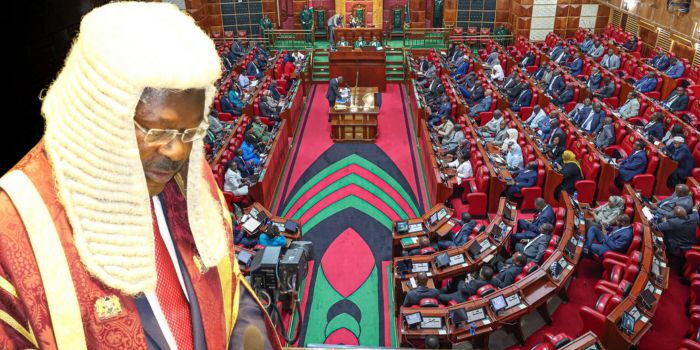
The High Court of Kenya has temporarily stopped the National Assembly from forwarding a proposed constitutional amendment bill to the President for approval.
The decision effectively pauses the legislative process at a critical stage, halting any chance of the bill being signed into law until the court fully hears and decides on the matter.
The ruling was issued by Justice Lawrence Mugambi, who stated that although Parliament is allowed to debate and even send the Constitution of Kenya (Amendment) Bill, 2025 to the Senate, it cannot go any further — particularly not to the President for assent.
This injunction follows a legal challenge by the Katiba Institute, a civil society group that filed a court application on May 2, 2025, seeking to stop the bill’s progression.
Following the court’s decision, Katiba Institute said in a statement:
“Justice Mugambi has granted our oral request for interim conservatory orders.
These orders prevent Parliament from forwarding the Constitution Amendment Bill, 2025, to the President for signing, pending the court’s hearing and judgment on the application we filed on May 2.”
Norah Mbagathi, the Executive Director of the Institute, stressed the importance of adhering to constitutional procedures when changes to the supreme law are proposed.
“When the Constitution is at stake, it is essential that every step of the process respects the rule of law and the values enshrined in our founding legal document,” she said.
The bill in question, which was first introduced in the National Assembly on March 12, 2025, is sponsored by Members of Parliament Otiende Amollo and Samuel Chepkonga. It proposes several key changes, most notably the inclusion of three major financial programs in the Constitution:
- The National Government Constituency Fund (NG-CDF)
- The Senate Oversight Fund (SOF)
- The National Government Affirmative Action Fund (NGAAF)
To gather public feedback, the National Assembly began a nationwide public participation process on May 7, 2025, targeting all 290 constituencies. The exercise was advertised through newspapers and published on the official National Assembly website.
However, Katiba Institute strongly opposes the bill. The organization argues that the proposed amendments are not only redundant but also go against the spirit and principles of the current Constitution.
According to the Institute, the bill promotes unnecessary public spending and does not align with the Constitution’s emphasis on responsible and accountable use of public resources.
Additionally, the Institute raised concerns that certain sections of the bill are so significant that they would require approval through a national referendum.
They emphasized that Parliament has not yet passed a referendum law, despite being constitutionally obligated to do so for the last 14 years. In their view, it is illegal and premature to move forward with constitutional amendments without first having such a legal framework in place.
The court’s intervention now means that Parliament cannot proceed to submit the bill for presidential assent until the court fully examines the legality and constitutionality of the entire process.
Join Gen Z New WhatsApp Channel To Stay Updated On time https://whatsapp.com/channel/0029VaWT5gSGufImU8R0DO30
