


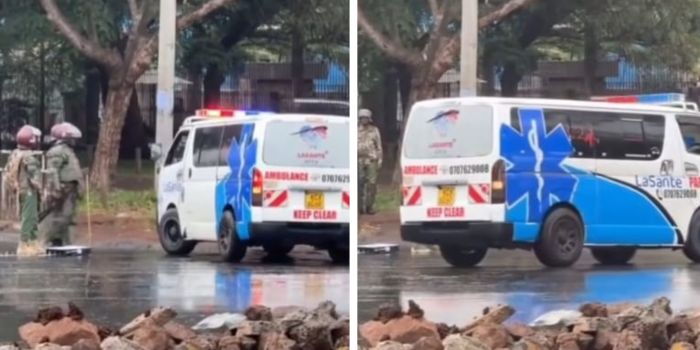
A video circulating online has caused widespread concern among Kenyans, after it showed police officers turning away an ambulance at a roadblock in Nairobi.
The incident happened during a major police operation aimed at preventing residents from accessing the Central Business District (CBD) on July 7.
The roadblocks were part of a wider security effort to stop people from gathering in the city centre, where protests related to the Saba Saba Day were expected.
Saba Saba Day, first marked in 1990, is a historic day in Kenya that pushed for multi-party democracy and remains symbolic of the fight for political freedom.
The video has sparked mixed reactions, with many Kenyans expressing anger and disappointment at the decision to block an emergency vehicle. Among the institutions that strongly condemned the move was the National Gender and Equality Commission (NGEC).
The commission demanded that police officers and other security agents ensure the unhindered movement of ambulances, medical personnel, pregnant women, persons with disabilities (PWDs), and other vulnerable individuals who may urgently need medical care.
In a firm statement, the NGEC urged authorities to respect human dignity, constitutional rights, and public health needs. “We call upon security agencies to uphold dignity, humanity, and constitutional rights.
Ensure free passage for doctors, ambulances, pregnant women, PWDs, older persons, and anyone seeking medical attention,” the statement read. “Sections 43 and 54 of the Constitution guarantee access to healthcare and protection of vulnerable groups. Let us not violate these rights under the guise of maintaining order.”
The disturbing incident was further confirmed by a police officer stationed at a roadblock in Karen, located at the junction of Ushirika Road and Gataka Road.
Speaking to a local reporter, the officer plainly stated, “No one is allowed to pass here, not even ambulances.” This response mirrors the situation reported across Nairobi and its surrounding areas.
Human rights activists are already raising alarm over the lack of emergency services, particularly in Ngong, where several people are reported to have been shot during clashes with police.
Many of the injured have reportedly gone without urgent medical assistance due to the roadblocks and restricted movement.
The police began erecting barricades as early as 4:00 a.m. on Monday morning, blocking major routes and leaving many daily commuters stranded.
Thika Superhighway was among the worst affected roads, with multiple roadblocks placed at the TRM roundabout, Roasters, Alsops, and Guru Nanak areas. Other major roads such as Waiyaki Way, Mombasa Road, and Ngong Road also faced similar closures.
The extensive police presence and road closures forced many Kenyans to cancel or postpone their business plans in the CBD. Shops and offices remained shut, and the normally bustling city centre turned into a ghost town.
BBC journalist Ian Wafula shared his experience of encountering a police officer in town, who casually told him there was “no news” for him that day, indicating that journalists were also being restricted from reporting on the events.
While the city remained tightly guarded, reports from areas on the outskirts of Nairobi painted a troubling picture. Violent clashes were reported in towns such as Ngong, Kitengela, Kiserian, and Mwea. So far, at least five people are confirmed to have died during the unrest.
July 7, known as Saba Saba Day, marks a turning point in Kenya’s political history. It was on this day in 1990 that citizens took to the streets demanding democratic reforms, which eventually led to the introduction of multiparty politics.
The spirit of that day continues to inspire political activism in Kenya, but the events of this year have raised serious concerns about civil rights, police conduct, and access to emergency services during times of unrest.
Join Gen Z New WhatsApp Channel To Stay Updated On time
https://whatsapp.com/channel/0029VaWT5gSGufImU8R0DO30
