


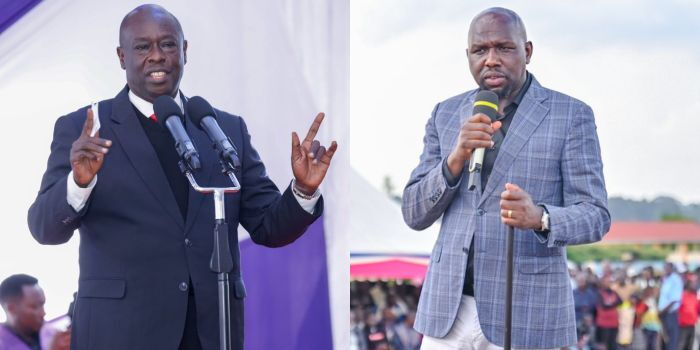
Gachagua Pushes for International Travel Sanctions on CS Murkomen Over Sudan Claims
Democracy for Citizens (DCP) party leader, Rigathi Gachagua, has called for the international community to consider imposing travel sanctions on Interior Cabinet Secretary Kipchumba Murkomen.
He accuses the Cabinet Secretary of playing a role in allegedly allowing individuals linked to Sudan’s ongoing conflict, including those he describes as war criminals, to operate and live freely within Kenya.
Speaking during his remarks, Gachagua claimed that Kenya’s international reputation in matters of peace, diplomacy, and regional security has been significantly damaged.
He further alleged that decisions made by President William Ruto and CS Murkomen have weakened Kenya’s standing in global diplomatic circles, especially in discussions involving stability in the Horn of Africa region.
He stated that Kenya’s image, which has long been associated with mediation and peacebuilding, is now under strain.
According to him, the country’s influence in international security discussions has been “greatly reduced” due to recent internal political and security-related decisions.
Gachagua also described Murkomen as a “weak link” in Kenya’s security structure, suggesting that leadership decisions within the Interior Ministry are affecting how both allies and neighbouring countries view Kenya’s commitment to law, order, and regional stability.
At the centre of his allegations is Mohamed Hamdan Dagalo, commonly known as Hemedti, the commander of Sudan’s paramilitary Rapid Support Forces (RSF).
Gachagua claimed that Hemedti, despite facing international sanctions in connection with the Sudan conflict, has allegedly been granted special treatment in Kenya.
He further alleged that Hemedti has been issued diplomatic documents, including what he referred to as a Kenyan passport, and that he is currently residing in the upscale Runda area of Nairobi.
Gachagua also claimed that the RSF leader is living there with his family and that state security units, including the General Service Unit (GSU), are providing protection.
According to Gachagua, this situation is “embarrassing to Kenya” and raises serious questions about how diplomatic privileges are being issued.
He specifically alleged that sanctioned individuals and their families are being allowed access to high-level protection and residence within the country.
He went further to urge international actors to go beyond targeting Sudanese figures and instead impose sanctions on Murkomen himself.
In his remarks, Gachagua suggested that such sanctions should restrict the Cabinet Secretary from travelling outside Kenya, arguing that he is directly responsible for facilitating what he termed as safe haven arrangements for individuals under international sanctions.
Meanwhile, Hemedti’s RSF group has been widely accused by international organisations and human rights bodies of serious abuses during Sudan’s ongoing conflict.
Reports from various monitoring groups have linked the RSF to civilian killings, mass displacement, destruction of property, and widespread violations of human rights during the war.
Tensions between Kenya and Sudan escalated further in February 2025 after RSF-linked leaders and allied groups reportedly held meetings in Nairobi.
During the gathering, they signed a charter proposing the formation of a parallel government in Sudan.
This development sparked strong criticism from multiple quarters, including within Africa and the wider international community.
In response, Sudan recalled its ambassador from Kenya, marking a serious diplomatic fallout. Khartoum accused Nairobi of interfering in its internal affairs and indirectly supporting factions it considers hostile and destabilising to its sovereignty.
The African Union also expressed concern over the situation, warning that attempts to establish a parallel administration could worsen divisions in Sudan and potentially deepen the ongoing conflict.
Analysts have since described the situation as a major test for Kenya’s diplomatic balance in the region.
Separately, Gachagua has also continued to accuse the Interior Ministry of being involved in political interference.
He alleged that groups of hired individuals are being used to disrupt political rallies linked to the opposition, specifically the United Opposition movement and the DCP party.
He blamed the government for incidents of violence and destruction of property that reportedly occurred during a political rally in Kikuyu.
He also linked the Interior Ministry to an alleged attack on Vihiga Senator Godfrey Osotsi in Kisumu, claiming the incident nearly turned fatal.
The government has not officially responded in detail to these latest claims, but the accusations continue to add tension to Kenya’s already heated political and diplomatic environment.
Join TUKO KADI Official WhatsApp Channel to stay updated on time
https://whatsapp.com/channel/0029VaWT5gSGufImU8R0DO30
