


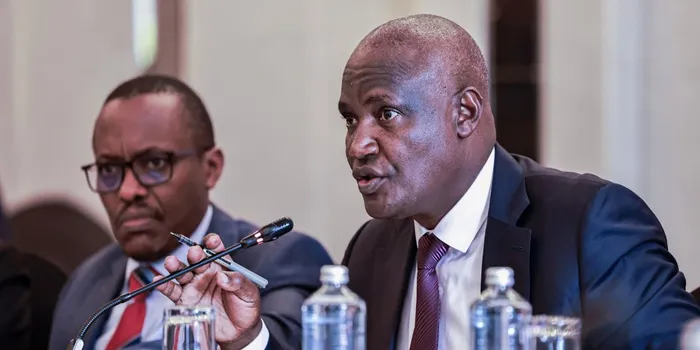
Treasury Cabinet Secretary John Mbadi has officially appointed six new members to the Board of the National Infrastructure Fund (NIF), a major step towards making the newly created fund fully operational.
The appointments are expected to strengthen the management of the fund as the government seeks to finance major infrastructure projects across the country.
The appointments were published in a special edition of the Kenya Gazette released on Wednesday, July 8, with all six members assuming office immediately.
According to the gazette notice, the newly appointed board members are James Mworia Mwirigi, Fahima Ali Ahmed Zein, Christopher Kibui Maranga, Latoya Ouna, Lawrence Kibet, and Mohammed Abdirahman Hassan.
Among those appointed, James Mworia Mwirigi is a well-known Kenyan lawyer, accountant, and corporate executive who currently serves as the Managing Director and Chief Executive Officer of Centum Investment Company.
He brings years of experience in finance, investment, and corporate leadership. Lawrence Kibet, another appointee, currently serves as the Director General for Public Investments and Portfolio Management at the National Treasury, where he oversees government investment portfolios and public assets.
The appointments come at a time when the government is accelerating efforts to fully operationalise the National Infrastructure Fund.
The fund was established to provide a reliable and long-term source of financing for strategic infrastructure projects while reducing the country’s dependence on borrowing and expensive external loans.
Through the fund, the government hopes to finance development projects using locally generated resources and proceeds from strategic investments.
The National Infrastructure Fund attracted national attention earlier this year after the government transferred Ksh103.45 billion into the fund as its initial capital.
The money came from the sale of a 65 percent stake in the Kenya Pipeline Company (KPC), making it one of the largest funding injections into the newly established infrastructure fund.
The Treasury has also outlined additional plans to increase the fund’s financial capacity. One of the key strategies involves using proceeds from the planned partial sale of the government’s shares in a leading telecommunications company.
The transaction is expected to generate approximately Ksh244 billion, including Ksh204 billion from the sale of shares and an additional Ksh40.2 billion that will be paid upfront instead of future dividend payments.
These resources are expected to significantly strengthen the fund’s ability to finance major national development projects.
One of the biggest projects expected to receive funding from the National Infrastructure Fund is the Ksh154.2 billion Phase One modernisation of Jomo Kenyatta International Airport (JKIA).
According to the government, the project is aimed at transforming Kenya’s main international airport into a modern aviation hub capable of handling increasing passenger and cargo traffic.
Preliminary works at the airport have already started as preparations continue for the larger construction phase.
The JKIA modernisation project will involve extensive upgrades to the existing passenger terminals, improvements to airfield infrastructure, and the construction of a brand-new passenger terminal.
Once completed, the expansion is expected to increase the airport’s annual passenger handling capacity from the current 7.5 million passengers to approximately 22 million passengers, while also improving cargo handling facilities to support trade and economic growth.
In addition to the airport project, the National Infrastructure Fund will also finance the planned expansion of the 160-kilometre Nairobi-Namanga Highway.
The road will be upgraded into a modern dual carriageway complete with toll stations to improve traffic flow, reduce travel time, and enhance connectivity between Nairobi and the Kenya-Tanzania border.
The government believes the upgraded highway will promote regional trade, support economic development, and improve transport efficiency for both businesses and motorists.
With the appointment of the new board members, the government is expected to move faster in implementing the National Infrastructure Fund’s mandate.
Officials believe the fund will play a critical role in financing large-scale infrastructure projects, boosting economic growth, creating employment opportunities, and reducing the country’s reliance on public debt to fund development initiatives.
Join WANTAM Official WhatsApp Channel to stay updated on time
https://whatsapp.com/channel/0029VaWT5gSGufImU8R0DO30
