


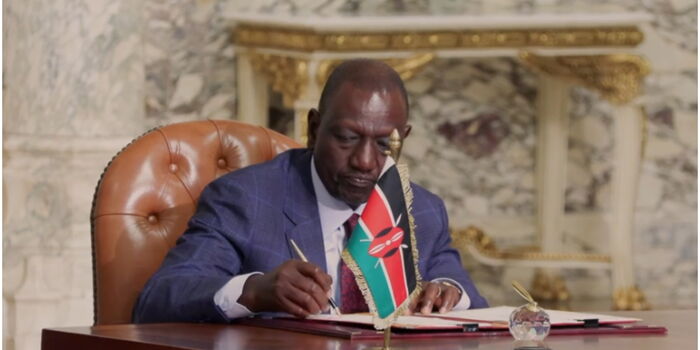
President William Ruto has stepped in to address concerns over bursary distribution in counties, issuing fresh orders to Education Cabinet Secretary Julius Ogamba.
On Thursday afternoon, while speaking in Murang’a County, Ruto directed CS Ogamba to convene a meeting with governors to resolve the bursary distribution issue and ensure students continue receiving financial aid.
The Head of State instructed Ogamba and Murang’a Governor Irungu Kang’ata to urgently bring together all governors and agree on a framework that allows counties to continue issuing bursaries to needy students.
Ruto expressed his full support for county bursary programs, stating that both the national and county governments have a shared responsibility in ensuring all children access quality education.
Criticism of Controller of Budget Margaret Nyakang’o
While addressing residents, President Ruto strongly criticized Controller of Budget Margaret Nyakang’o for opposing bursary issuance at the county level.
He described her stance as a backward move that would negatively impact students who depend on county funds to stay in school.
“I do not support the Controller of Budget’s directive that counties should stop issuing bursaries. That is why I have ordered the Ministry of Education to immediately engage county governments and reach a consensus so that bursary distribution can continue,” Ruto stated firmly.
The President argued that all students, regardless of where their bursary comes from, deserve equal support. “All pupils are our children.
What difference does it make whether the bursary is issued by the national government or the county government? What matters is that our children remain in school,” he added.
Background on the Bursary Dispute
The bursary dispute started two months ago when Nyakang’o directed counties to stop issuing bursaries for primary, secondary, and tertiary education, arguing that it was a function of the national government.
In a statement issued on January 15, she insisted that counties were only permitted to offer financial aid for pre-primary education and vocational training institutions, as per the Fourth Schedule of the Constitution.
Nyakang’o further explained that if counties wished to distribute bursaries for other levels of education, they must first enter into a formal intergovernmental agreement with the national government, as required under Article 187 of the Constitution.
She emphasized that counties could only take on education-related functions if the national government officially transferred those responsibilities.
“Under Part 1 of the Fourth Schedule, universities, tertiary institutions, primary schools, special education, and secondary schools fall under the jurisdiction of the national government,” Nyakang’o wrote in a letter to governors.
However, her directive sparked strong opposition from governors, who argued that the Constitution does not explicitly restrict counties from issuing bursaries.
Many county leaders expressed frustration, stating that the move would disadvantage thousands of students who rely on county-funded scholarships to pursue their education.
The Way Forward
Following Ruto’s intervention, county governments are now expected to hold discussions with the Ministry of Education to find a lasting solution.
The President’s directive signals relief for students and parents who were worried about losing financial support for school fees.
As the discussions unfold, it remains to be seen whether a formal agreement will be reached between county and national governments, allowing counties to legally continue supporting students with bursaries.
However, Ruto’s firm stance suggests that the government is keen on ensuring that no child is denied an education due to a lack of school fees.
Join Gen z and millennials TaskForce official 2025 WhatsApp Channel To Stay Updated On time the ongoing situation https://whatsapp.com/channel/0029VaWT5gSGufImU8R0DO30
