


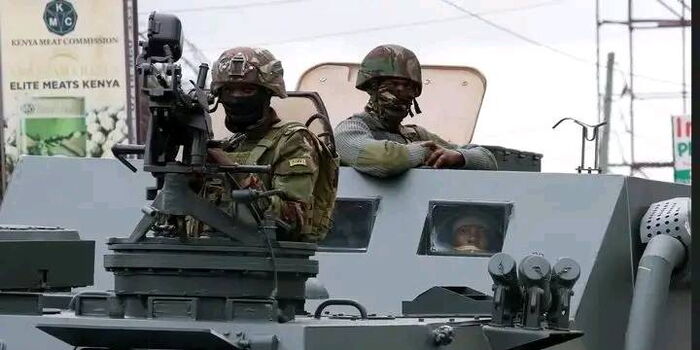
On Monday, July 7, Kenya Defence Forces (KDF) officers were deployed along key parts of the Nairobi-Nakuru highway as Saba Saba protests escalated and posed a threat of turning into widespread violence.
Eyewitnesses reported spotting the KDF soldiers stationed at various strategic points along the busy highway. Some of the officers were even seen at the Safari Centre in Naivasha after a failed attempt by rowdy youths to break into a Naivas Supermarket in the area.
Before the deployment of the military, several areas stretching from Waiyaki Way in Nairobi to parts of Nakuru experienced serious disruptions.
Protesters lit fires, blocked roads with stones, and brought transport along the highway to a standstill. These disruptions were mainly caused by criminal elements who had infiltrated the peaceful protests.
In Nakuru’s Free Area, large groups of young people took to the streets in anger. Their demonstrations caused heavy traffic jams, leaving drivers and passengers stranded for hours. There was growing concern over the lack of a visible police response as the chaos unfolded.
However, calm slowly returned once the KDF officers arrived. Armed with full military gear and using armoured vehicles, they managed to restore order along the affected parts of the highway.
Interestingly, the presence of KDF soldiers was met with a surprisingly positive reaction from residents in Nairobi, Naivasha, and Nakuru.
Unlike the hostile receptions often given to anti-riot police officers, images obtained by Newshub.co.ke showed residents and KDF personnel interacting peacefully. In some places, people were even seen smiling and talking with the soldiers, creating a stark contrast to the tense scenes involving the police.
This warm reception has sparked discussions online about the different ways civilians respond to the military compared to the police. Many citizens noted that while the police were caught in running battles with protesters throughout the afternoon, the arrival of KDF officers appeared to defuse tensions in some areas.
Despite the positive reception, the presence of the military in public protest zones has triggered concern among some Kenyans. They worry that this could lead to the normalisation of using soldiers for duties traditionally handled by the police.
According to Kenya’s 2010 Constitution and the Kenya Defence Forces Act, the military is allowed to respond to internal disturbances, but only under very special conditions. Article 241(3)(b) of the Constitution permits military intervention in cases of national disaster or to help restore peace — but such actions must be approved by Parliament.
The Defence Act further requires that any deployment of KDF within civilian areas be officially published in the Kenya Gazette within 24 hours. This notice must include specific details such as the duration, scope, and exact location of the deployment.
It is worth noting that this is not the first time KDF soldiers have been used to manage protests. In 2023, following nationwide unrest, then-Defence Cabinet Secretary Aden Duale ordered the military to protect critical infrastructure beginning June 25.
Those orders have remained in effect, allowing the military to be called upon again if needed to support national security efforts.
As the Saba Saba demonstrations continue to unfold, the involvement of the KDF may remain a topic of national debate, especially regarding the role of the military in civilian matters and how far their involvement should go.
Join Gen Z New WhatsApp Channel To Stay Updated On time
https://whatsapp.com/channel/0029VaWT5gSGufImU8R0DO30
