


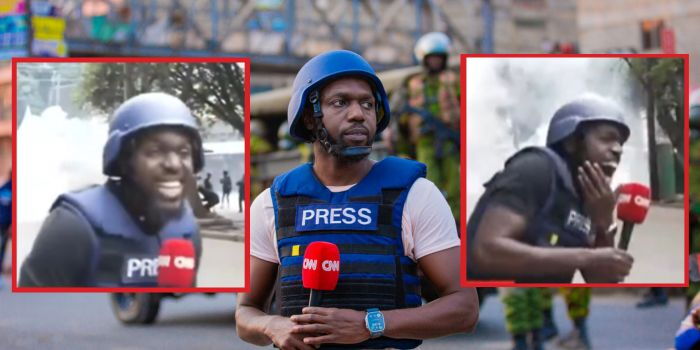
CNN’s international correspondent Larry Madowo has made a serious claim, saying that a Nairobi politician offered Ksh100,000 to a group of hired attackers with instructions to target him during the recent Saba Saba demonstrations.
On Monday, while addressing the situation, Madowo revealed that the goons openly admitted on camera that they had been promised extra payment if they attacked him.
According to the journalist, these individuals complained that they had not been fully paid for their involvement in earlier protests, which is what led them to speak out.
Despite the threats, Madowo made it clear that the reason he didn’t attend the Saba Saba protests was not out of fear.
He explained that he had prior commitments in Nigeria related to his work as an international correspondent. “We will not be intimidated. Journalism is not a crime,” Madowo boldly stated.
He went on to say that aside from the physical threats—plans to beat him and destroy his equipment—he has also faced online harassment from government-affiliated social media accounts. Additionally, a certain lawmaker has been publicly calling for his arrest on accusations of inciting violence during the protests.
Although Madowo didn’t directly name anyone, Homa Bay Town MP Peter Kaluma had, the previous day, posted on social media demanding the arrest of Madowo and other journalists he described as troublemakers.
Kaluma accused them of encouraging unrest through their reporting ahead of the Saba Saba protests. The controversial post was later deleted.
Kaluma, however, is not the only politician targeting Madowo. Following the June 25 protests, Interior Cabinet Secretary Kipchumba Murkomen also criticized international correspondents of Kenyan origin. He accused them of reckless reporting that, in his view, paints the country in a bad light.
Murkomen argued that when these journalists report on events in Western nations, they exercise a lot of caution. However, when covering Kenyan issues, they focus heavily on the negative aspects because that’s what earns them praise abroad.
He suggested that this approach might be motivated by a desire to gain approval from Western audiences.
“They are very cautious when reporting from other countries. But when they report on Kenya, they don’t hold back. Some of them even seem proud when they portray Kenya negatively, thinking they have succeeded because they receive applause from foreign countries,” said Murkomen.
He added that the government sometimes has to consider whether to allow media freedom or to intervene based on national interest. “The question about shutting down or not depends on the situation. You must weigh national interest against the freedom of media houses,” he explained.
In addition to Larry Madowo, other Kenyan journalists working with global media outlets who have been actively covering the protests include Ian Wafula from BBC, Catherine Soi from Al Jazeera, and Edith Kimani from Deutsche Welle (DW).
These journalists have all been reporting on the events as they unfold in Kenya for an international audience, which has sparked mixed reactions from local authorities and politicians.
Join Gen Z New WhatsApp Channel To Stay Updated On time
https://whatsapp.com/channel/0029VaWT5gSGufImU8R0DO30
