


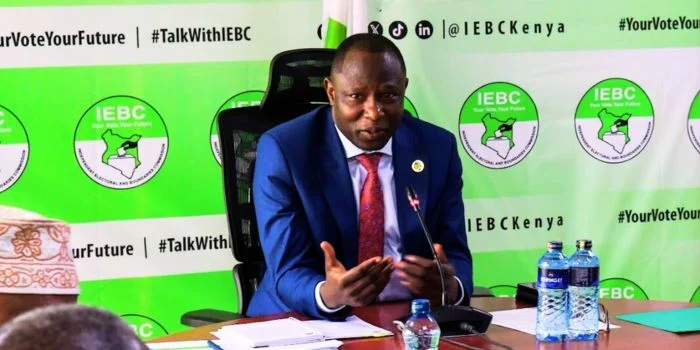
The Independent Electoral and Boundaries Commission (IEBC) has warned that continued delays in reviewing electoral boundaries could pose a serious risk to the smooth conduct of the 2027 General Election.
Speaking to the media on Tuesday, January 27, IEBC Chairperson Erastus Ethekon said the commission has already gone beyond the constitutional timeline set for boundary delimitation.
According to the Constitution, electoral boundaries should be reviewed every eight to twelve years. However, the last review was conducted in 2012, meaning the next review should have been completed by March 2024.
Ethekon explained that boundary delimitation is a critical democratic process because it ensures fair representation and upholds the constitutional principle of “one person, one vote, one value.”
He noted that without updated boundaries, population imbalances across constituencies could lead to unequal representation, which may undermine the credibility and fairness of future elections.
While acknowledging the importance of the exercise, the IEBC chair outlined several challenges that have stalled progress.
He said prolonged court cases, especially those surrounding the 2019 national census data, have been a major setback. Since the census figures are still under legal dispute, the commission cannot legally rely on them to guide population-based boundary reviews.
“Despite the efforts made, the boundary delimitation process faced serious challenges that slowed it down and prevented its timely completion,” Ethekon said. “We have already exceeded the constitutional timelines, which require the exercise to be done within eight to twelve years. The last deadline lapsed in March 2024.”
He added that the delays were caused by a combination of factors, including the absence of IEBC commissioners for more than two years, legal challenges to the 2019 census data, ongoing court cases in three counties, exposure to legal risks related to boundary reviews, and the need for advisory opinions from the Supreme Court.
Ethekon stressed that electoral boundary delimitation plays a vital role in adjusting constituencies to reflect population changes over time. Without this adjustment, some constituencies may remain overpopulated while others fall below the required population threshold, raising concerns about fairness and equal representation.
The IEBC chair noted that although census data is central to the boundary review process, the commission is currently unable to use the 2019 census because the matter is still before the courts. Until the legal disputes are resolved, he said, the commission’s hands remain tied.
Under the Constitution, IEBC is required to complete the review of constituency and ward boundaries at least one year before a general election.
However, Ethekon admitted that this deadline has already been missed. He further warned that boundary delimitation is a complex process that usually takes up to two years to complete, making the situation even more concerning.
His remarks came shortly after Prime Cabinet Secretary Musalia Mudavadi suggested that the 2027 General Election could potentially be nullified even before it is held if constitutional requirements are not met.
Mudavadi also proposed that a constitutional referendum could be held alongside the 2027 elections, a statement that sparked nationwide debate, with mixed reactions from political leaders and the public.
Ethekon emphasised that the commission cannot proceed with publishing a preliminary boundary review report or issuing a formal notice of intention to delimit boundaries while the census data remains disputed.
He said population quotas, which are central to the delimitation process, must be based on legally approved data.
If the 2019 census had been available for use, the IEBC would have identified between 27 and 40 constituencies that risk being merged or scrapped for failing to meet the constitutional population threshold.
Based on the census, the average population per constituency stands at about 164,137 people, with the minimum allowable limit set at approximately 114,889. Constituencies falling below this threshold are required by law, under Article 89 of the Constitution, to be merged or abolished.
Several regions across the country would be affected. At the Coast, constituencies such as Voi, Wundanyi, Mwatate, Galole, Bura, Lamu East, Lamu West and Mvita have been flagged. In Central Kenya, areas including Othaya, Ndaragwa, Tetu, Mukurweini, Kangema and Mathioya are also at risk.
Other potentially affected constituencies are in Samburu East and North, Keiyo and Marakwet, parts of Isiolo, Marsabit and Makueni, as well as Budalang’i, Teso North and South, and Kuria East and West. Some County Assembly wards in regions with declining populations could also face restructuring or reduction.
Despite the challenges, Ethekon revealed that the IEBC has not been idle. Since 2019, the commission has carried out substantial preparatory work, including developing operational plans, conducting situational analyses and training staff.
However, he cautioned that moving ahead without resolving the existing legal disputes could expose the commission to further court cases, potentially causing even more delays.
The IEBC has therefore reiterated the urgent need for legal clarity to allow the boundary review process to move forward and safeguard the integrity of the 2027 General Election.
Join Tutam Official WhatsApp Channel to stay updated on time
https://whatsapp.com/channel/0029VaWT5gSGufImU8R0DO30
