


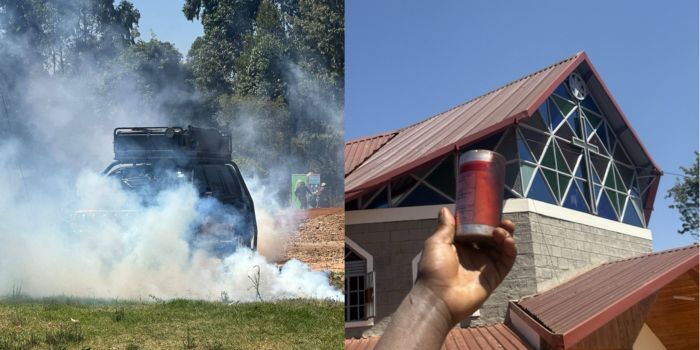
“Somebody Is Giving Teargas to the Wrong People” – Murkomen Speaks After Rally Chaos
Interior Cabinet Secretary Kipchumba Murkomen has responded to claims by opposition leaders that the government is responsible for the repeated use of teargas during political rallies across the country.
Speaking during a security briefing in the North Rift region, Murkomen said investigations are ongoing to determine how teargas canisters are ending up in the hands of civilians.
The CS explained that there have been worrying incidents where teargas was used in places where there were no police officers deployed.
According to him, this raises serious questions about who is supplying the canisters and how they are being accessed. He suggested that it is possible some of the teargas may have fallen into the wrong hands.
“It is possible that we have teargas canisters in the wrong hands because, in some instances, even where there was no police presence, we have seen teargas being used in rallies,” Murkomen stated.
He further revealed that the Inspector General of Police has already launched investigations to establish whether civilians are illegally holding teargas canisters or whether there could be any form of collusion involving rogue security officers.
Murkomen insisted that the matter is being treated with urgency due to the potential danger posed to the public.
According to his preliminary findings, some of the teargas canisters being used by civilians appear to be those that had previously failed to explode when thrown by police officers during crowd control operations.
He added that there is also a possibility that certain individuals could be distributing teargas illegally for political or criminal purposes.
“I can tell you for sure it is not police officers who are using those teargas, and they are not used under the command and direction of police officers in charge,” he said firmly.
Murkomen has recently found himself at the center of a political storm as the National Police Service and opposition leaders continue to trade accusations over the violence and chaos that have disrupted several opposition rallies in different parts of the country. Each side has blamed the other, deepening political tensions.
Violent Incident in Othaya Church
One of the most shocking incidents occurred on January 25, 2026, at Witima ACK Church in Othaya, Nyeri County. The church service was attended by former Deputy President Rigathi Gachagua and several opposition leaders.
During the service, armed individuals, some reportedly wearing hoods, stormed the church compound. Witnesses said the attackers fired live bullets into the air and threw teargas canisters directly inside the church sanctuary.
The sudden release of chemical fumes caused panic among hundreds of worshippers, including children, infants, and elderly members of the congregation.
The situation quickly turned chaotic as congregants rushed to escape the smoke-filled church. The panic led to a stampede, with several people sustaining injuries while trying to find safety.
In the midst of the confusion, Gachagua’s personal vehicle was set on fire. Other vehicles in his motorcade were also vandalized and destroyed.
Gachagua and his allies described the incident as a state-sponsored assassination attempt, accusing the government of targeting opposition leaders.
However, government officials strongly denied the allegations and instead accused the opposition of allegedly “staging” or exaggerating the violence to gain public sympathy and political mileage.
Rising Political Tension in 2026
The attack at Witima Church is seen as part of a larger pattern of growing political tension in 2026. The United Opposition, which includes leaders such as Gachagua, Kalonzo Musyoka, and Eugene Wamalwa, has been holding rallies across the country. However, many of these events have faced disruption, often involving police action.
Earlier this month, a major rally in Embu was interrupted when police officers used teargas to disperse crowds that had gathered to listen to Kalonzo Musyoka.
Authorities cited security concerns and claimed the assembly was not authorized. Supporters of the opposition, however, argued that the action was unnecessary and aimed at silencing dissenting voices.
A similar incident took place in Mombasa later in the month. An opposition consultative meeting was broken up by anti-riot police who deployed water cannons and teargas.
The confrontation resulted in several injuries and led to a tense standoff that lasted for hours, as supporters clashed verbally with security officers.
In another separate incident, a rally led by Nairobi Senator Edwin Sifuna in Kitengela was also disrupted. Sifuna had been addressing a large crowd about the rising cost of living when police officers moved in and fired heavy volleys of teargas to disperse the gathering.
The sudden action forced Sifuna and his supporters to run for safety, seeking refuge in nearby shops and buildings.
Thick smoke covered parts of the town center, causing businesses along Namanga Highway to temporarily shut down as traders and customers fled the area.
Ongoing Debate Over Responsibility
As these incidents continue to unfold, questions remain about who is truly responsible for the repeated chaos witnessed at political gatherings.
While opposition leaders insist that state security agencies are deliberately targeting their events, Murkomen maintains that the police are not acting outside the law and that any misuse of teargas is being investigated thoroughly.
The controversy has intensified public debate over security management, political freedom, and the safety of citizens attending rallies and public gatherings.
With investigations ongoing, many Kenyans are now waiting for clear answers and accountability as political temperatures continue to rise across the country.
Join Tutam Official WhatsApp Channel to stay updated on time
https://whatsapp.com/channel/0029VaWT5gSGufImU8R0DO30
