


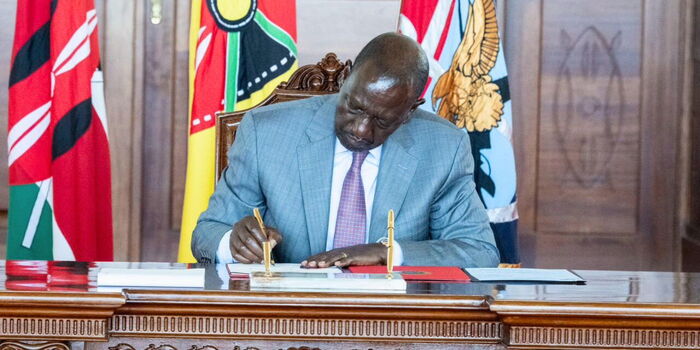
Ruto Appoints National Infrastructure Fund Governing Council
President William Ruto has officially named the leadership team that will steer Kenya’s newly created National Infrastructure Fund (NIF), a major vehicle expected to transform how the country finances large-scale development projects.
The appointments, published on Wednesday, April 1, follow the coming into force of the National Infrastructure Fund Act, 2026, which now gives legal backing to the ambitious KSh5 trillion initiative.
At the centre of the appointments is Treasury Cabinet Secretary John Mbadi, who has been named Chairperson of the seven-member Governing Council.
He will work alongside Attorney General Dorcus Oduor and Central Bank Governor Kamau Thugge, both of whom join the council as statutory members. Their presence is expected to strengthen the legal, fiscal, and regulatory foundation of the fund as it begins operations.
President Ruto also appointed four respected independent members to the council: Professor Benedict Oramah, Paul Russo, Faith Boinett, and Richard Etemesi.
Their inclusion adds strong private-sector and continental financial expertise to the governing body, which is expected to approve strategic investment structures and major financing agreements for key national projects.
One of the most notable appointments is Paul Russo, the Chief Executive Officer of KCB Group and Chairperson of the Kenya Bankers Association Governing Council. With more than two decades of experience in banking and financial services, Russo brings critical expertise in capital mobilisation, institutional finance, and risk management.
His presence on the board strongly signals the government’s intention to make the fund attractive to both local and international investors, especially as it moves toward private-sector-led financing models.
Professor Benedict Oramah’s appointment is equally significant. As Chairperson of the Fund for Export Development in Africa (FEDA) and the African Medical Centre of Excellence, as well as the immediate former President of Afreximbank, he brings extensive continental experience in development finance and trade expansion.
His deep understanding of cross-border investment and infrastructure funding is expected to help position Kenya’s projects within larger African and global financing ecosystems.
The National Infrastructure Fund was first unveiled by President Ruto late last year as part of a broader strategy to reduce Kenya’s dependence on debt-funded development. Instead of relying on traditional sovereign borrowing, the government plans to mobilise capital through a private-sector-driven investment framework.
Major funding sources are expected to include proceeds from the privatisation of state-owned firms such as the Kenya Pipeline Company, public-private partnerships, pension schemes, sovereign investors, and institutional capital pools.
The fund is expected to finance some of Kenya’s most transformative flagship projects. Among the first projects lined up are the extension of the Standard Gauge Railway to Malaba, the modernisation and expansion of Jomo Kenyatta International Airport, upgrades to road networks, strategic dams, and other high-impact economic infrastructure.
These projects are seen as central to improving Kenya’s regional competitiveness and strengthening its position as East Africa’s economic gateway.
In February, President Ruto revealed that the government aims to raise at least half of the KSh5 trillion target—about KSh2.5 trillion—within a short period, underscoring the administration’s aggressive push to move from planning to execution.
The vision ties into what the President has often described as his “Singapore dream,” an economic transformation agenda aimed at moving Kenya toward first-world infrastructure standards through commercially viable and politically insulated investment structures.
Importantly, the governing council will oversee the fund as a Limited Liability Company, a structure deliberately designed to allow operational independence, professional investment decisions, and protection from day-to-day political interference.
This model is intended to give the fund the flexibility of a commercially run institution while still serving Kenya’s long-term national development goals.
Overall, these appointments mark a major milestone in Kenya’s shift toward innovative infrastructure financing.
By blending government oversight with top-level banking, legal, and continental development expertise, the National Infrastructure Fund now has a leadership team capable of driving one of the country’s most ambitious economic transformation plans in recent history.
Join Kenya Govt Official WhatsApp Channel to stay updated on time
https://whatsapp.com/channel/0029VaWT5gSGufImU8R0DO30
