


150 Kenyan Police Officers Return from Haiti as Tensions Rise Among Locals
Kenya has officially welcomed home another group of police officers who had been serving in Haiti, marking a significant step toward the conclusion of the country’s peacekeeping role in the troubled Caribbean nation.
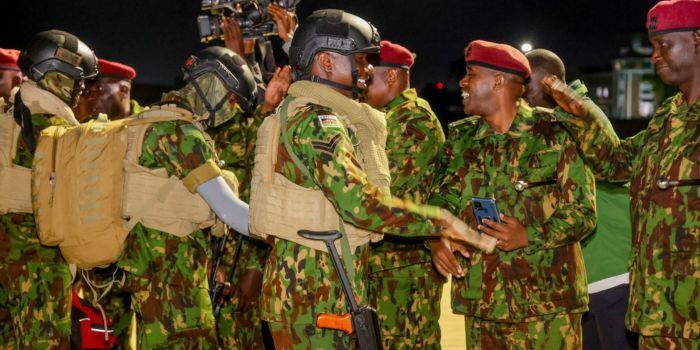
The latest group, made up of 150 officers, returned after completing their assignment under the Kenya-led Multinational Security Support (MSS) Mission.
The officers landed at Jomo Kenyatta International Airport on the evening of Tuesday, April 2.
They were accompanied by Deputy Inspector General Gilbert Masengeli and were warmly received by Inspector General Douglas Kanja, alongside several senior officers from the National Police Service.
Their arrival was marked by a formal reception that recognized their contribution to international peacekeeping efforts.
In an official statement, the police confirmed the safe return of the officers, noting that this fourth contingent had successfully completed its duties in Haiti.
This return is part of a broader, phased withdrawal process that has seen Kenyan officers come back home in batches since the mission began in 2024.
The gradual exit signals the nearing end of Kenya’s involvement in the MSS mission, which was launched to help restore order in Haiti during a period of intense instability.
Previously, another group of 215 officers had also returned to Kenya, further reducing the Kenyan presence in the Caribbean nation.
The mission itself, supported by the United Nations, has been winding down as responsibility for maintaining security transitions to other international forces.
However, the departure of Kenyan officers has not been without controversy. Their withdrawal has sparked concern and unrest among Haitian citizens, many of whom fear that the absence of the peacekeeping force could leave them vulnerable to criminal gangs.
On Monday, April 20, protests broke out in the capital, Port-au-Prince, where residents attempted to stop the officers from leaving.
Demonstrators blocked key roads using barricades in areas such as Petite Rivière and Pont-Sondé, creating tense standoffs.
The situation escalated to the point where authorities had to use helicopters to safely evacuate the Kenyan officers from their bases.
These dramatic scenes highlighted the level of fear and uncertainty among locals, who worry that the progress made in improving security could quickly unravel.
The protests were largely driven by anxiety over rising gang violence. Many Haitians believe that the departure of the Kenyan-led force could create a security gap, making it easier for armed groups to regain control of key areas.
Their actions reflected a deep concern about the country’s fragile stability and the potential consequences of losing international support.
Despite these challenges, the Kenyan officers are credited with making meaningful progress during their 18-month deployment.
Since arriving in 2024, they played a key role in securing important infrastructure, including the main airport and several hospitals.
They also helped reopen major roads that had been blocked or controlled by gangs, improving movement and access within the country.
In addition, the officers supported the return of more than 2,000 Haitian police personnel, strengthening local law enforcement capacity.
Their efforts contributed to a partial stabilization of Port-au-Prince, allowing some level of normal life to resume. Residents experienced improved freedom of movement, and essential services began to function more reliably.
As Kenya concludes its mission, a new security arrangement is taking shape, with Chad stepping in to take over responsibilities through a separate force.
While the transition marks the end of Kenya’s direct involvement, the impact of its officers’ work is expected to remain significant in Haiti’s ongoing efforts to restore peace and stability.
Join TUKO KADI Official WhatsApp Channel to stay updated on time
https://whatsapp.com/channel/0029VaWT5gSGufImU8R0DO30
