


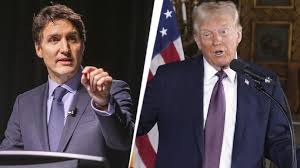
In response to U.S. President Donald Trump’s decision to impose tariffs on Canadian goods, Prime Minister Justin Trudeau has announced retaliatory measures, slapping a 25% tariff on $155 billion worth of American imports. Despite the gravity of the situation, Trudeau revealed that he and Trump have not yet spoken directly about the escalating trade tensions.
Canada’s Plan for Retaliation
Trudeau outlined a two-phase response:
- Immediate Action: Starting Tuesday, Canada will impose tariffs on $30 billion worth of American goods.
- Broader Impact: An additional $125 billion in tariffs will be implemented within the next 21 days, giving Canadian businesses time to adjust and find alternative suppliers.
Speaking from Parliament Hill, Trudeau urged Canadians to prioritize domestic products in their purchasing decisions. He suggested choosing Canadian alternatives over American goods, such as selecting locally made rye whiskey instead of Kentucky bourbon or skipping Florida orange juice altogether.
“The actions taken by the White House today divide us instead of bringing us together,” Trudeau stated.
He also warned Americans about the real consequences of Trump’s decision, emphasizing that the new tariffs would lead to job losses in the U.S., disrupt manufacturing, and drive up prices for essential goods like food and fuel.
Products that will soon cost more for U.S. consumers include beer, wine, vegetables, clothing, shoes, household appliances, furniture, and sporting goods. Trudeau further hinted that Canada is considering non-tariff measures in the energy and mineral sectors, in coordination with provincial leaders, to ensure the burden is distributed evenly across industries.
“This will only work if Canadians stand together as one,” he said.
Emergency Talks & Diplomatic Efforts Fail
The announcement follows weeks of intense diplomatic discussions aimed at preventing a full-scale trade war. Trudeau met with his cabinet and provincial leaders on Saturday to finalize Canada’s historic countermeasures.
“If President Trump wants to usher in a golden age for the United States, the better approach is to work with Canada—not to punish us,” Trudeau remarked.
He expressed frustration at Trump’s refusal to engage in direct discussions despite repeated attempts to reach him.
Trump’s Tariffs Take Effect on Tuesday
Trump officially signed an executive order imposing steep tariffs on Canada, Mexico, and China on Saturday afternoon. The new tariffs, set to take effect at 12:01 a.m. on Tuesday, include:
- Canada: 25% tariff on imports, plus a 10% tariff on energy exports such as oil, natural gas, and electricity.
- Mexico: 25% tariffs on all imports, including energy.
- China: 10% tariffs across the board.
Following the announcement, Trudeau immediately convened an emergency cabinet meeting, then held a conference call with provincial premiers to brief them on Canada’s response.
One senior cabinet source suggested that Trump could escalate the situation further by doubling the tariffs in response to Canada’s retaliation.
“We did not start this, but we will not back down,” Trudeau declared.
Mexico Joins the Fight
Mexican President Claudia Sheinbaum has also ordered her government to impose tariffs on American goods. She directed her Secretary of Economy to implement trade restrictions to safeguard Mexico’s economic interests.
For weeks, federal and provincial governments in Canada have been preparing for a worst-case scenario, working closely with businesses and stakeholders as part of a unified “Team Canada” strategy to respond to Trump’s economic aggression.
Backlash from Canadian Leaders
Political leaders across Canada have strongly condemned Trump’s actions. British Columbia Premier David Eby labeled the tariffs a “betrayal” of the longstanding relationship between Canada and the U.S. In response, he announced that B.C. liquor stores would stop selling alcohol from Republican-led U.S. states.
Other premiers have also taken measures to support Canadian businesses and minimize the impact of the tariffs.
Trump’s Justification for Tariffs
According to a White House statement, Trump claims that his decision is necessary to address what he calls a national “emergency” and a “public health crisis.” The administration argues that illegal immigration and drug smuggling—particularly fentanyl—justify these sweeping economic measures under the International Emergency Economic Powers Act (IEEPA).
“The extraordinary threat posed by illegal aliens and drugs, including deadly fentanyl, constitutes a national emergency,” the White House stated.
Trump, speaking from his Mar-a-Lago resort, insisted that the tariffs will remain in place “until the crisis is resolved.” He also defended his approach as a necessary tool to strengthen U.S. borders.
However, Canadian officials have repeatedly pointed out that illegal crossings and fentanyl trafficking from Canada to the U.S. are minimal. In fact, U.S. Customs and Border Protection reported seizing just 43 pounds of fentanyl at the northern border in the entire 2024 fiscal year.
The Canadian government has already made significant investments—over $1.3 billion—to enhance border security, deploying additional personnel, drones, surveillance technology, and helicopters to prevent illegal crossings and drug smuggling.
Opposition Leaders Demand Parliament’s Return
The tariffs have sparked strong reactions from Canada’s opposition leaders.
Conservative Leader Pierre Poilievre condemned Trump’s move, calling it a “massive, unjustified economic attack” on Canada’s struggling economy. He urged the government to retaliate with equivalent tariffs while ensuring minimal harm to Canadian businesses.
NDP Leader Jagmeet Singh echoed these concerns, warning that Trump has “unleashed an unprecedented trade war.” He called for immediate financial assistance for affected workers and a strong commitment to buying Canadian-made products. Singh also advocated cutting off the U.S. supply of critical minerals as leverage.
Both Poilievre and Singh are demanding that Parliament be recalled to address the crisis. Currently, Parliament is prorogued following Trudeau’s announcement of his resignation, and it is not set to reconvene until March 24.
While Canada’s current countermeasures do not require parliamentary approval, government sources suggest that a large-scale economic relief package—comparable to pandemic-era stimulus efforts—may be introduced. Such a package would need approval from Parliament.
Trade War Could Hurt Both Economies
Trump’s tariffs come after weeks of conflicting statements from his administration about their timing and scope. Initially, reports suggested a March 1 start date, but Trump later confirmed that nothing could be done to delay the February 1 deadline.
The Canada-U.S. trade relationship is one of the largest in the world. Every day, $3.6 billion in goods and services flow across the border, amounting to $1.3 trillion annually. Millions of jobs on both sides of the border depend on this economic partnership.
Canada is the largest supplier of energy to the U.S., providing:
- 99% of U.S. natural gas imports
- 85% of U.S. electricity imports
- 60% of U.S. crude oil imports
Despite Trump’s repeated claims of an unfair trade deficit, U.S. data shows that, excluding oil exports, the U.S. actually enjoys a trade surplus with Canada.
Economic experts predict that a 25% tariff could shrink Canada’s GDP by 2.6% and cost the average Canadian household $1,900 annually. Meanwhile, American households could see a 1.6% GDP drop and pay an extra $1,300 per year due to higher costs on imported goods.
Business Leaders Warn of Economic Fallout
The U.S. Chamber of Commerce has criticized Trump’s tariffs, stating that escalating trade tensions will not solve the issues he wants to address.
“These tariffs will only raise prices for American families and disrupt supply chains,” the Chamber said in a statement.
As tensions mount, Canada remains firm in its response. Trudeau has made it clear that Canada will not be bullied into submission. Whether Trump escalates the trade war further remains to be seen, but one thing is certain—this economic standoff is just beginning.
Join Gen z and millennials official 2025 WhatsApp Channel To Stay Updated On time the ongoing situation https://whatsapp.com/channel/0029VaWT5gSGufImU8R0DO30
