


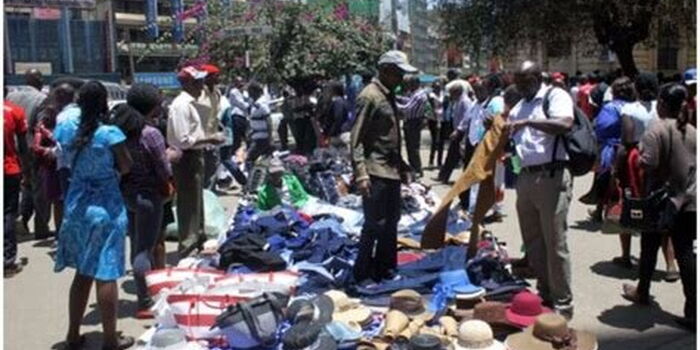
Kileleshwa MCA Robert Alai on Tuesday, September 9, introduced new proposals aimed at reforming how business and order are managed in Nairobi’s Central Business District (CBD). Among his suggestions was a requirement that all hawkers operating in the city centre should wear uniforms.
Alai, who has consistently pushed for accountability within the Nairobi County government, directed sharp criticism at Governor Johnson Sakaja following a press briefing the governor held on Monday.
During that press conference, Sakaja outlined several measures to address the growing security concerns in the CBD. However, Alai expressed disappointment, describing Sakaja’s actions as inadequate.
According to Alai, Nairobians are tired of empty talk. “We need fewer press conferences and more concrete action,” he said, stressing the urgent need to curb insecurity in the city centre.
He argued that introducing uniforms for hawkers could help bring some order to the chaotic CBD while also calling for stricter regulation of the number of Public Service Vehicles (PSVs) allowed within the city at any given time.
Alai further urged Nairobi County to work more closely with national security agencies to ensure lasting solutions to the insecurity problem.
Hawkers and Order in the CBD
The issue of hawkers in Nairobi’s CBD has always been a sensitive one. Successive county administrations have struggled to balance the interests of informal traders, who depend on the streets for their livelihoods, with the need to maintain order, safety, and smooth movement of pedestrians and motorists.
Earlier in January, the Sakaja administration issued a stern warning to hawkers, prohibiting them from conducting business along major streets and roads. The county insisted that these areas were strictly meant for pedestrians.
Streets like Moi Avenue, Haile Selassie Avenue, Kenneth Matiba Road, Latema Road, Ronald Ngala Street, Mfangano Street, Hakati Road, and River Road were declared no-go zones for hawkers.
However, the directive was met with stiff resistance from traders who argued it would deny them a source of income.
Uniforms for Hawkers – A Global Perspective
Although Alai’s proposal may sound unusual, similar strategies have been implemented in other countries with positive outcomes. In India, for instance, the Street Vendors Act of 2014 requires municipal bodies to issue uniforms or identification cards to all registered vendors.
Cities such as Mumbai and Delhi have run pilot programs where hawkers are given jackets, aprons, or vests to distinguish them as licensed traders.
While uniforms may not be a direct solution to insecurity, Alai believes they could play an important role in helping authorities differentiate genuine traders from individuals who use hawking as a disguise to commit crimes.
Criminal elements often blend in with street vendors, making it hard to detect them. Uniforms or IDs would make it easier for enforcement officers to identify unregistered or illegal traders operating in the CBD.
Alai’s Criticism of Sakaja
Alai’s latest remarks came just a week after Governor Sakaja narrowly survived an impeachment attempt. The motion was temporarily suspended for 60 days, giving the governor a chance to review his leadership style and reconcile with Members of the County Assembly (MCAs).
The outspoken Kileleshwa MCA has been one of Sakaja’s fiercest critics. He has repeatedly accused the county government of failing to deliver essential services such as garbage collection, road maintenance, and proper infrastructure management.
According to Alai, the governor’s administration has fallen short of meeting the expectations of Nairobi residents.
By proposing reforms such as hawkers’ uniforms and stricter regulation of PSVs, Alai is positioning himself as a strong voice for order, security, and better governance in Nairobi’s busy city centre.
Join Government Official WhatsApp Channel To Stay Updated On time
https://whatsapp.com/channel/0029VaWT5gSGufImU8R0DO30
