


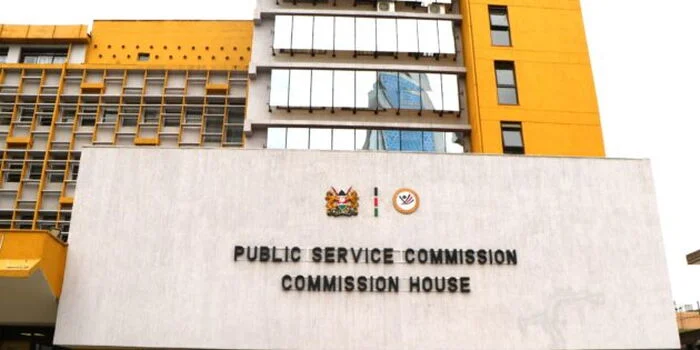
Government Dismisses Claims of Civil Servants’ Salary Cuts, Assures Workers of Improved Pay
The government has moved to calm growing concern among public servants by firmly dismissing reports suggesting that civil servants’ salaries are set to be reduced.
Officials have clarified that there are no plans to lower pay, assuring workers that recent changes in the remuneration structure are intended to improve earnings rather than introduce salary cuts.
The clarification comes after speculation circulated claiming that the government had begun revising salaries downward. These claims emerged at a time when civil servants in Kenya had just started receiving a salary increase for the year 2026.
The increment was backdated to July 1, 2025, following approval by the Salaries and Remuneration Commission (SRC) under Phase One of the 2025–2029 remuneration and benefits review cycle.
Public Service Cabinet Secretary Geoffrey Ruku addressed the issue, stating that the government’s main focus is to enhance the take-home pay of public servants rather than reduce it.
He explained that recent salary adjustments were misunderstood and that the government remains committed to improving the welfare and motivation of civil servants across different sectors.
Speaking during an interview on Radio Citizen on Wednesday, Ruku dismissed the claims as inaccurate and unnecessary. He noted that the government had only recently implemented salary increases and therefore had no reason to reverse the decision.
He urged public officers not to be alarmed by unverified reports and encouraged them to continue concentrating on service delivery to citizens.
The Cabinet Secretary further explained that any decision involving salary reductions would require approval through the legislative process.
According to him, only Parliament of Kenya has the authority to pass laws that would allow such changes, and currently, there is no proposal before lawmakers seeking to reduce civil servants’ pay.
He reassured workers that there is no cause for panic, emphasizing that the government has not discussed or considered salary cuts at any level.
The revised salary structure, which officially took effect on January 1, applies to public officers across grades CSG1 to CSG17, as well as other designated job groups within the national government.
Under the new framework, allowances are determined based on factors such as job classification, level of responsibility, and geographical location of deployment.
One of the major changes introduced in the new system is the Salary Market Adjustment (SMA). This adjustment combines several previous allowances, including entertainment, domestic servant, and extraneous allowances, into a single payment.
The move is intended to simplify payroll management, reduce administrative complexity, and ensure that compensation remains competitive with prevailing market conditions.
House allowances have also been reorganized into three different clusters to reflect variations in the cost of living across the country. Cluster One covers Nairobi, where living expenses are highest.
Cluster Two includes major urban centres such as Mombasa, Kisumu, and Nakuru, along with several large municipalities.
Cluster Three applies to all other regions, mainly smaller towns and rural areas, where the cost of living is comparatively lower.
According to SRC guidelines, civil servants working in Nairobi are expected to benefit the most from the revised house allowance due to higher housing costs in the capital.
Officers stationed in other regions will receive allowances adjusted to match local economic conditions, ensuring fairness while maintaining sustainability in public spending.
For example, officers in higher grades such as CSG4 will earn a basic salary ranging between Ksh185,690 and Ksh396,130.
Those posted in Nairobi may receive house allowances of up to Ksh140,600. On the other hand, lower-grade officers, including those in CSG15, will earn between Ksh21,120 and Ksh26,250, with house allowances reaching up to Ksh4,500 depending on their duty station.
The SRC has explained that the introduction of the SMA and other adjustments is meant to align public service compensation with economic realities while ensuring compliance with constitutional and legal principles governing public pay.
The current increment represents the first phase of the fourth remuneration review cycle covering the period between 2025 and 2029, with additional reviews and possible adjustments expected in later phases as the process continues.
Overall, government officials maintain that the ongoing reforms are aimed at creating a more structured, transparent, and fair pay system for civil servants, while at the same time safeguarding public finances and improving motivation within the public service.
Join Tutam Official WhatsApp Channel to stay updated on time
https://whatsapp.com/channel/0029VaWT5gSGufImU8R0DO30
