


Explained: Why Ruto’s 12% Salary Increase Will Not Appear in Payslips Immediately
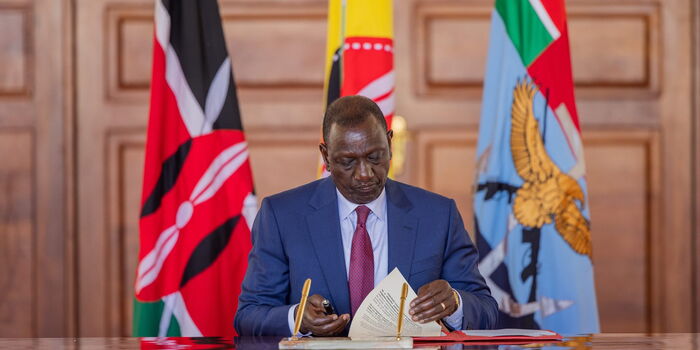
Many Kenyan workers were excited after President William Ruto announced a 12 per cent salary increase for workers during the Labour Day celebrations held on May 1.
Following the announcement, many employees expected the new pay adjustment to start reflecting in their salaries at the end of this month.
However, despite the excitement created by the announcement, workers may still have to wait for some time before the increase officially appears in their payslips.
This is because the President’s declaration alone does not automatically change salaries immediately. Several legal and administrative steps must first be completed before employers are required by law to implement the increase.
Under Kenya’s labour and wage laws, a presidential announcement on wages mainly serves as a policy direction or an expression of government intention. It does not instantly become a legally binding order that employers can enforce right away.
Before companies and institutions begin paying workers under the new rates, the proposal must pass through official government procedures and regulatory processes.
This means that although the government has already communicated its intention to raise wages by 12 per cent, the process is still at an early stage.
For the wage increase to take legal effect, it must first be formally published in the Kenya Gazette. Until that happens, employers are not yet under any legal obligation to adjust salaries.
Labour experts explain that gazettement is an important step because it officially transforms the announcement into a recognised legal directive.
Without publication in the Kenya Gazette, the announcement remains more of a public statement rather than an enforceable law.
After the gazettement process is completed, another important stage will follow. Employers, workers’ unions, and labour stakeholders will need to hold consultations and negotiations to agree on how the increase will be applied across different sectors and organisations.
These discussions are expected to focus on key details surrounding the implementation of the wage rise. For example, parties will need to agree on whether the 12 per cent increase will apply to the basic salary only, allowances only, or both combined.
Different industries and companies may also adopt varying approaches depending on their wage structures and existing agreements.
Labour unions are also expected to play a major role during this stage by representing employees and ensuring that workers benefit fairly from the proposed increment.
Employers, on the other hand, may seek clarity on how to absorb the additional wage costs without affecting business operations.
Once negotiations are concluded and agreements reached, employers will then be required to begin implementing the directive internally.
This process could involve updating payroll systems, revising employment contracts, adjusting salary structures, and preparing new payslips that reflect the approved increase.
Only after all these legal and administrative requirements are completed will Kenyan workers finally start receiving the additional pay announced by President Ruto.
Meanwhile, over the weekend, Francis Atwoli, the Secretary General of the Central Organisation of Trade Unions (COTU), moved to clarify confusion surrounding the announcement after different interpretations emerged from employers and workers.
Atwoli stressed that the President’s announcement should not be misunderstood as a minimum wage adjustment targeting only low-income earners.
According to him, the 12 per cent increase was intended as a general wage increase covering all Kenyan workers across different categories.
“The President was very clear. This is a general wage increase for all Kenyan workers and not only for those earning minimum wage,” Atwoli stated.
He also criticised remarks made by the Federation of Kenya Employers (FKE), which had reportedly interpreted the announcement as a minimum wage adjustment.
Atwoli insisted that employers should not narrow the scope of the directive, maintaining that the intention was to ensure workers broadly benefit from improved earnings during a period when many Kenyans continue struggling with the high cost of living.
The clarification by labour unions is expected to intensify discussions between workers, employers, and the government in the coming weeks as the country waits for the official legal processes required to activate the new wage structure.
Join TUKO KADI Official WhatsApp Channel to stay updated on time
https://whatsapp.com/channel/0029VaWT5gSGufImU8R0DO30
