


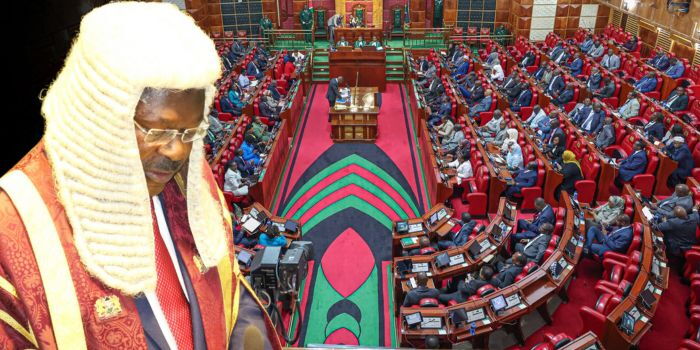
High Court Stops Parliament from Sending Constitution Amendment Bill to the President
The High Court has temporarily stopped the National Assembly from sending a proposed constitutional amendment to the President for approval.
Justice Lawrence Mugambi issued the order, stating that although Parliament is free to discuss and pass the Constitution of Kenya (Amendment) Bill, 2025, and even forward it to the Senate, the process must stop there. The Bill cannot proceed to the President for assent at this stage.
This development follows a petition filed in court by the Katiba Institute. The constitutional rights organization moved to court on May 2, 2025, asking for temporary orders to block the Bill from advancing to the President until their case is fully heard and determined.
After the ruling, Katiba Institute issued a statement confirming that Justice Mugambi had granted their oral request for conservatory orders. These orders will remain in place while the main application, filed earlier in May, is being handled in court.
“Justice Mugambi has granted our oral request for temporary conservatory orders to stop Parliament from sending the Constitution of Kenya (Amendment) Bill, 2025 to the President. This will remain in place until our court case, which was filed on May 2, 2025, is heard and resolved,” the Katiba Institute announced.
The group emphasized the importance of strictly following constitutional procedures when considering any amendments to the supreme law of the land.
“When it comes to changing our Constitution, we must uphold the right procedures and honor the values that the Constitution stands for,” said Katiba Institute’s Executive Director, Norah Mbagathi.
The Bill in question was introduced in the National Assembly on March 12, 2025. It is sponsored by MPs Otiende Amollo and Samuel Chepkonga.
The main purpose of the Bill is to officially include three specific Funds in the Constitution: the National Government Constituency Fund (NGCF), the Senate Oversight Fund (SOF), and the National Government Affirmative Action Fund (NGAAF).
Since its introduction, the National Assembly has taken steps to involve the public. It has announced a countrywide public participation exercise in all 290 constituencies, which began on May 7, 2025.
The public was notified through newspaper advertisements and updates posted on the National Assembly’s website.
However, Katiba Institute has strongly opposed the Bill. The organization argues that the Bill is unnecessary and contradicts the values and principles found in the Constitution.
They say that the funds being proposed are not only redundant but also go against the constitutional principles of responsible and prudent use of public funds.
Furthermore, the lobby group claims that the Bill contains amendments that cannot be made without holding a national referendum.
According to them, Parliament must first pass a referendum law — something it has failed to do since the 2010 Constitution came into effect — before attempting to make such major changes.
Katiba Institute insists that the lack of a proper legal framework for holding a referendum makes the entire process flawed and unconstitutional.
Until that framework is in place, they argue, Parliament has no legal basis for pushing forward any amendments that require approval from the Kenyan people through a referendum.
As the court prepares to hear the full case, Parliament will have to pause any further steps in trying to amend the Constitution through this Bill. The legal battle is expected to draw significant public interest as it could have a lasting impact on how constitutional changes are handled in Kenya.
Join Gen Z New WhatsApp Channel To Stay Updated On time https://whatsapp.com/channel/0029VaWT5gSGufImU8R0DO30
