


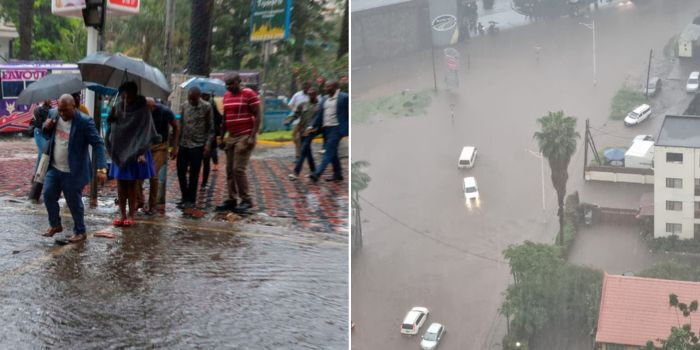
Kenya Met Forecasts Heavy Rainfall and Potential Flooding Throughout April
The Kenya Meteorological Department (Kenya Met) has issued a warning that the ongoing long rains are expected to persist across much of the country throughout April.
While the first half of the month may see slightly lighter rainfall, the intensity is forecasted to increase in the later weeks, raising the risk of flooding in various regions.
Residents in the Rift Valley counties, the Lake Victoria Basin, and neighboring areas should prepare for widespread rainfall. Some parts, especially along the borders with Uganda and South Sudan, may also experience occasional storms.
These conditions are expected to affect daily activities and could pose challenges for communities living in flood-prone zones.
Counties located east of the Rift Valley, including Nairobi, Nyandarua, Laikipia, Kiambu, and Embu, are likely to record above-average rainfall.
The combination of storms and cooler daytime temperatures is expected to enhance rainfall intensity in these areas.
The Kenya Met explained that this rainfall pattern is largely influenced by the northward movement of the Intertropical Convergence Zone (ITCZ).
This system brings in moist air from the Indian Ocean and the Congo Air-mass over Kenya’s highlands, fueling significant rain activity, particularly across central and western regions.
Northeastern counties, such as Marsabit, Wajir, and Mandera, are also expected to receive rainfall above normal levels, while coastal regions may experience less precipitation than usual.
Farmers and residents in the highlands east and west of the Rift Valley, the Lake Victoria Basin, and northwestern Kenya are advised to prepare for near-average rainfall during this period.
The Kenya Met urges farmers to strengthen field drainage, unclog irrigation furrows, and avoid practices that compact already wet soils, which could worsen flooding risks.
Counties in this category typically include Western, Nyanza, Nairobi, Central, and Rift Valley regions.
In contrast, eastern parts of Turkana and Samburu counties are likely to experience rainfall at or slightly below average.
Similarly, areas in Marsabit, Wajir, Garissa, and Isiolo are forecasted to receive near-to-below-normal rainfall, although occasional storms may still occur. Residents in these regions are advised to remain vigilant and take precautionary measures where necessary.
Temperature Outlook
The Kenya Met also provided a temperature outlook for April, noting that most parts of the country will experience warm and wet conditions.
Daytime highs are expected to range from 20°C to 32°C. Highland regions will remain cooler due to elevation, while coastal areas and lowlands in northern and northeastern Kenya are likely to see higher daytime temperatures.
Nighttime temperatures will generally be cooler in the highlands but remain warmer along the coast and in northeastern counties.
Flooding Risks and Precautions
Following the flooding incidents seen in March, Kenya Met has warned that similar situations could repeat in April. Water resource managers are advised to monitor river levels closely and take proactive steps to prevent flooding.
“The continued April rains may cause renewed flooding in some areas. Water agencies should maintain round-the-clock monitoring of river levels and clear clogged drainage and riparian obstructions,” the report noted.
Road management authorities have also been put on alert, as the heavy rains are expected to disrupt transport and potentially damage road infrastructure.
Residents and drivers are advised to exercise caution, especially in flood-prone areas and along low-lying roads that may become hazardous during heavy downpours.
Overall, the April outlook emphasizes vigilance and preparedness, with communities urged to take necessary precautions to mitigate the impact of heavy rains, storms, and potential flooding across Kenya.
Join Kenya Govt Official WhatsApp Channel to stay updated on time
https://whatsapp.com/channel/0029VaWT5gSGufImU8R0DO30
