


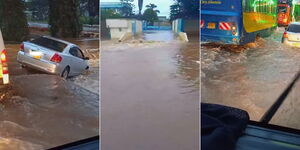
Heavy Traffic on Mombasa Road After Overnight Rains Disrupt Movement in Nairobi
Heavy rains that fell overnight have caused major transport disruptions across Nairobi, leaving several roads flooded and many motorists stranded for hours. Movement in different parts of the city has been severely affected as water covered major roads and slowed traffic to a crawl.
One of the most affected areas is Mombasa Road, where flooding between Mlolongo and Cabanas created a huge traffic jam early on the morning of Saturday, May 1.
Witnesses reported that the congestion stretched for nearly three kilometres, from the Ole Sereni area to the Standard Media Group section.
Videos shared online showed trucks, private cars, and public service vehicles stuck in deep water, making it difficult for drivers to continue with their journeys. Flooding was also reported near Jomo Kenyatta International Airport (JKIA), raising concerns for travellers and airport users.
Many motorists said they had been trapped on the highway since the early hours of the morning and expressed frustration over the long delays.
Reports further indicated that the Eastern Bypass was also completely blocked due to flooding, forcing road users to look for alternative routes. Drivers were advised to use the Nairobi Expressway where possible to avoid the heavily affected roads.
Other sections of the city also experienced serious flooding. Along Jogoo Road, especially near the Makadara area and the Church Army roundabout, roads became difficult to pass as water levels rose quickly.
In Nairobi’s central business district and surrounding downtown areas, chaos was also reported. Landhies Road, which connects the OTC bus stage to Kamukunji, was submerged in water, making movement difficult for traders, commuters, and pedestrians.
Videos and photos circulating online also showed the Muthurwa Footbridge overflowing, with floodwaters spilling onto nearby roads and disrupting normal business activities in the area.
Public transport services were not spared either. Some reports suggested that the Nairobi Commuter Rail train travelling from Syokimau to Nairobi could not move beyond Imara Daima Station after floodwaters covered sections of the railway line.
Along Lang’ata Road, especially near the T-Mall area, which is known for frequent flooding during heavy rains, the road was temporarily impassable early in the morning. However, by around 7am, the water levels had started to reduce.
Witnesses in the area said at least two vehicles slid into a ditch near the Shell Petrol Station, while one truck reportedly fell completely into a drainage channel. Police officers were later seen responding to the scene and managing the situation.
The full extent of the destruction caused by the overnight rains has not yet been confirmed. However, the National Police Service (NPS) had earlier warned Nairobi residents to remain alert, especially those living near rivers and low-lying areas.
In a statement issued on April 29, the police noted that water levels in major rivers, including the Nairobi River, Mathare River, Ngong River, Kamiti River, and Athi River, had risen sharply. Authorities warned that these rivers drain into the larger Athi River system, which was already at dangerously high levels.
Officials are still assessing the impact of the floods in several estates and flood-prone neighbourhoods in and around Nairobi, including Lang’ata, Ngara, Madaraka, Eastleigh, Kawangware, Kibera, South C, Kasarani, Mathare, Mlolongo, and Syokimau.
Join TUKO KADI Official WhatsApp Channel to stay updated on time
https://whatsapp.com/channel/0029VaWT5gSGufImU8R0DO30
