


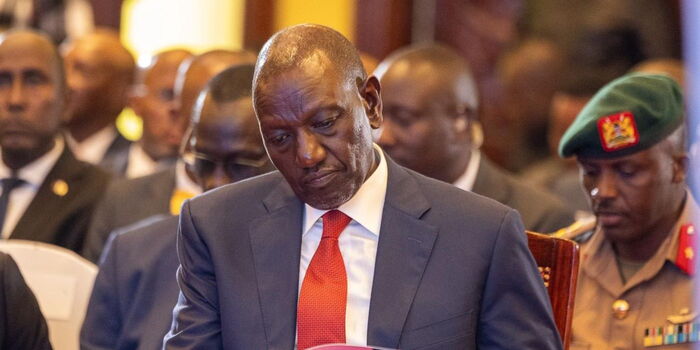
President William Ruto has finally spoken about the arrest and resignation of four senior officials linked to the Ksh4 billion substandard fuel scandal, saying his government is determined to deal firmly with corruption in the energy sector.
The Head of State addressed the matter on April 5 while speaking during a church service in Kilgoris, Narok County. In his remarks, Ruto made it clear that no one would be protected, regardless of how powerful or senior they are in the energy sector.
He said the arrest of the implicated officials is part of his administration’s wider plan to eliminate corruption in key government institutions.
Among those arrested are Petroleum Principal Secretary Mohamed Liban, Kenya Pipeline Company Managing Director Joe Sang, and Energy and Petroleum Regulatory Authority Director General Daniel Kiptoo.
According to the President, the action taken against them shows that his government is now moving beyond promises and is focused on taking real steps against corrupt dealings.
Ruto reminded Kenyans that when he came into office in 2022, he promised to fight corruption, even though many people doubted his commitment at the time. He said some believed his statements were only political talk, but recent developments prove that his administration is serious.
“In 2022, we said corruption must come to an end, and many people thought we were only making empty promises,” Ruto said. “Today, I want Kenyans to know that this is no longer about talking. We are taking action, and corruption must end in this country.”
The President also appeared to hint that some senior officials may have taken advantage of the ongoing tensions in the Middle East to create panic around fuel supply in Kenya for selfish financial interests.
He suggested that the international crisis may have been used as an excuse to manufacture an artificial fuel shortage locally, allowing certain individuals to profit from emergency deals.
He strongly warned that the energy cartels behind the scheme would not be allowed to continue operating freely. According to him, those responsible will face full accountability and will not escape justice.
“These cartels in the energy sector will not be allowed to continue with their games. They must be held accountable,” Ruto said. “It cannot be acceptable for people to use events in the Middle East as an excuse to create fake shortages and problems here at home.”
As he addressed the scandal, the President also linked the issue to his administration’s previous battles against cartels in other sectors, especially agriculture.
He pointed to the fertilizer, sugar, and coffee sectors, saying brokers and corrupt middlemen had previously made life difficult for farmers.
Ruto explained that after his government removed these cartels, farmers in the coffee and sugar industries began earning better returns for their produce. He said the reforms have helped restore fairness and improved incomes for ordinary farmers.
“We had powerful cartels in fertilizer, sugar, and coffee, and they were frustrating our farmers,” the President said. “We dealt with them firmly, and today those sectors are performing much better.”
He added that coffee farmers are now receiving better payments because the government dismantled the corrupt networks that had been exploiting the sector for years.
The same, he said, applies to sugar farmers, who are now seeing improved returns.
The four officials at the center of the fuel scandal are accused of allegedly manipulating fuel stock records to create the impression that the country was facing a shortage.
This false picture is said to have been used to justify emergency fuel purchases made outside the official government-to-government (G2G) supply arrangements.
Reports further indicate that the questionable fuel imported into the country was not only substandard but was also purchased at highly inflated prices, raising concerns over possible massive financial loss to the country.
The controversial consignment is said to involve a 60,000-metric-tonne cargo worth around Ksh4 billion. Investigations suggest that the fuel shipment was initially meant for Angola before it was illegally redirected to the Port of Mombasa, where it reportedly docked between March 27 and March 29 this year.
Despite the resignation of the four senior officials, public anger over the scandal continues to grow.
There has been increasing pressure from members of the public, civil society groups, and political leaders demanding the resignation of Energy and Petroleum Cabinet Secretary Opiyo Wandayi.
Many believe that a scandal of this scale could not have happened without the knowledge or awareness of the Cabinet Secretary. However, Wandayi has remained silent since the resignations and has not yet issued any public statement on the matter.
Adding another layer to the controversy, the Consumer Federation of Kenya (Cofek) on April 5 claimed that the Kenya Bureau of Standards (KEBS) allowed the substandard fuel to enter the local market.
This latest claim has intensified concerns among consumers and industry players, with many now questioning how the fuel passed quality checks and whether more agencies could be involved in the scandal.
The unfolding scandal has now become one of the biggest tests for Ruto’s anti-corruption agenda, especially in a sector as sensitive as energy, where any manipulation directly affects fuel prices, transport costs, and the overall cost of living for millions of Kenyans.
Join Kenya Govt Official WhatsApp Channel to stay updated on time
https://whatsapp.com/channel/0029VaWT5gSGufImU8R0DO30
