


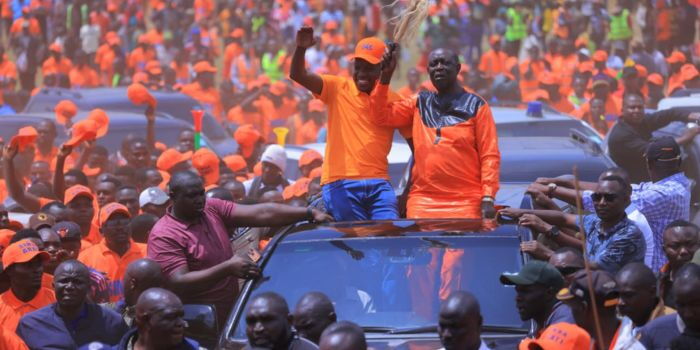
Fresh divisions have emerged within the Orange Democratic Movement (ODM), exposing growing internal disagreements among senior party leaders as debates over the party’s future direction continue to intensify.
The latest dispute follows public criticism by ODM leader Oburu Odinga directed at Secretary General Edwin Sifuna, deepening concerns about unity within one of Kenya’s major political parties ahead of the 2027 General Election.
The situation escalated on Saturday after ODM Deputy Party Leader and Vihiga Senator Geoffrey Osotsi openly disagreed with Oburu’s recent remarks.
Osotsi stressed that major political decisions, especially those concerning the party’s participation in the 2027 elections, must be made through proper consultation within the party’s official organs.
According to him, decisions such as whether ODM should field a presidential candidate, support another candidate, or enter into political coalitions cannot be made by individuals without wider agreement from party leadership structures.
Osotsi warned that failure to field either a presidential candidate or a running mate could significantly weaken ODM’s political relevance in the coming elections.
He argued that abandoning independent participation in national contests or forming a coalition with the ruling United Democratic Alliance (UDA) could erode the party’s identity and alienate its supporters.
In his view, ODM’s strength has always come from its independence and its ability to present itself as a strong alternative political force.
He further emphasized the importance of strengthening the party by empowering young leaders, pointing to Winnie Odinga’s increasing involvement in political campaigns as a positive development.
Osotsi noted that giving younger leaders more responsibility could help rejuvenate the party and maintain its connection with the youth, who form a large portion of its support base.
“The party leader of Bondo, whom I respect, is my colleague. I believe there is a need for more consultation because I do not remember any party organ resolving that we will not field a presidential candidate or that we are supporting someone else.
We have never agreed that ODM will not contest for the presidency or the deputy presidency,” Osotsi said.
He added that entering into a coalition with UDA or choosing not to present a candidate in the next election would be politically risky for ODM.
According to him, such decisions could gradually weaken the party and make it less relevant in national politics. “The surest way to finish ODM in 2027 is first to join a coalition with UDA, and second, to fail to field a presidential candidate or running mate.
ODM risks becoming obsolete if that happens. I urge leaders who are quick to support such moves to rethink their position,” he stated.
The ongoing tensions were triggered by Oburu Odinga’s strong criticism of Sifuna in an open letter released on Friday.
In the letter, Oburu accused the Secretary General of presenting personal opinions as official party positions, arguing that this had caused confusion among supporters and contributed to divisions within ODM ranks.
He maintained that party leaders must communicate carefully to avoid sending mixed signals to the public.
Oburu also defended the legitimacy of current party officials, stating that all office holders, including Sifuna, are serving lawfully in accordance with ODM’s constitution and internal resolutions.
He insisted that the party continues to operate within its established legal and organizational framework, dismissing claims that some leaders were occupying positions irregularly.
Responding to Sifuna’s continued claims that Oburu was not validly elected to his leadership position, Oburu pointed out what he described as inconsistency in the Secretary General’s arguments.
He noted that Sifuna himself previously served as Secretary General after being elected by the National Governing Council without facing similar objections, suggesting that the current criticism was selective.
Despite the sharp exchange of statements, Oburu did not indicate whether disciplinary measures would be taken against Sifuna.
The party remains divided between leaders who support Sifuna’s calls for ODM to maintain political independence and those who believe cooperation or coalition-building with UDA could be strategically beneficial ahead of the next election cycle.
For his part, Sifuna has remained firm, stating that he has no intention of stepping down from his position. He argued that only a properly convened delegates’ conference has the authority to remove him from office.
He has also raised concerns about what he described as possible government influence on ODM’s finances, warning that such interference could compromise the party’s independence.
Adding another voice to the debate, Ruth Odinga has in recent weeks defended Sifuna, saying his views on a possible UDA alliance reflect genuine concerns shared by many party members rather than an act of rebellion.
She drew comparisons with the late Raila Odinga’s political approach, noting that internal debate and differing opinions have historically played a role in shaping ODM’s political strategy.
As the disagreements continue to play out publicly, political observers say the outcome of the ongoing wrangles could significantly shape ODM’s direction as the country gradually shifts focus toward the 2027 elections.
The unfolding developments have raised questions about unity within the party and whether its leadership will be able to find common ground in time to present a united front to supporters.
Join Tutam Official WhatsApp Channel to stay updated on time
https://whatsapp.com/channel/0029VaWT5gSGufImU8R0DO30
