


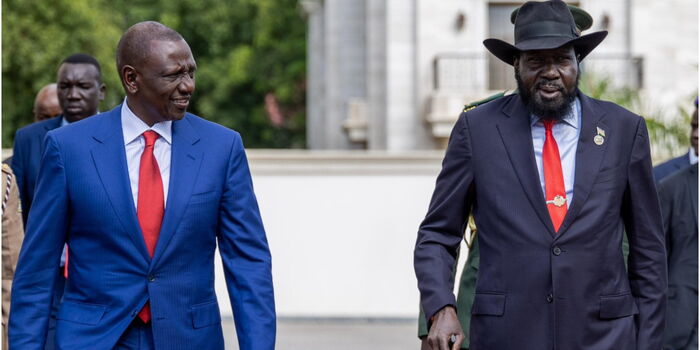
Ruto Outlines Kenya’s Support for South Sudan’s 2026 Elections
President William Ruto has announced that Kenya will play an active role in supporting South Sudan as it prepares for its long-delayed general elections scheduled for December 2026. The pledge comes at a time when South Sudan continues to struggle with political tensions, insecurity, and an uncertain peace process.
In a statement shared on his official social media platforms on January 28, President Ruto said Kenya was ready to help strengthen South Sudan’s electoral systems to ensure the polls are credible, peaceful, and well-organised.
He explained that Kenya would offer both capacity-building support and institutional assistance to South Sudan’s electoral body as part of regional efforts to stabilise the young nation.
“We are ready to support capacity building and institutional preparedness of South Sudan’s electoral agency ahead of the elections scheduled for later this year,” Ruto said.
The remarks followed a high-level meeting between President Ruto and South Sudan’s presidential special envoy, Tut Gatluak.
During the meeting, Gatluak delivered a message from South Sudan President Salva Kiir. Discussions centred on how regional partners, especially Kenya, can help strengthen democratic institutions in South Sudan and support a transparent and inclusive electoral process.
President Ruto further reaffirmed Kenya’s broader commitment to peace and stability in the region, noting that long-term security is key to economic growth and shared prosperity across East Africa.
“Kenya is committed to advancing regional peace and security, recognising that enduring stability is the foundation of shared prosperity across our region,” he added.
Kenya’s support comes at a difficult moment for South Sudan, which is once again facing rising tensions in several parts of the country.
In Jonglei State, the military has been accused of displacing thousands of civilians, with reports indicating that aid workers and United Nations personnel were ordered to leave the area.
These actions are widely seen as part of government efforts to regain control of territory believed to be held by opposition-linked forces.
South Sudan has a long history of postponed elections. Since gaining independence in 2011, the country has delayed national polls five times — in 2015, 2018, 2021, 2023, and 2024 — mainly due to insecurity, political disagreements, and failure to implement key reforms.
With the 2026 vote approaching, Kenya has expressed concern that another postponement could further weaken the country’s fragile political process.
The roots of South Sudan’s instability trace back to 2013, when a power struggle between President Salva Kiir and his then vice president, Riek Machar, escalated into a brutal civil war. The conflict claimed the lives of nearly 400,000 people and forced the cancellation of the 2015 elections.
In 2018, Kiir’s government signed a peace agreement with opposition groups led by Machar. The deal outlined several conditions that had to be met before elections could take place.
These included the unification of rival armed forces, the drafting of a permanent constitution to replace the transitional one, and the conduct of a national census. However, most of these conditions were never fully implemented, leading to repeated election delays.
Political tensions between Kiir and Machar worsened again in 2025. On March 26, South Sudanese security forces surrounded Machar’s residence in Juba and placed him under house arrest. The government claimed the move was meant to prevent possible election interference and armed rebellion.
After months of confinement, Justice Minister Joseph Geng Akech announced on September 11 that Machar and seven of his associates had been formally charged with treason, murder, and crimes against humanity.
A day later, President Kiir officially suspended Machar from his position as vice president, a decision that dealt a serious blow to the already fragile 2018 peace agreement.
Machar made his first public appearance since his arrest on September 22, when he was presented in a barred cage as his trial began before a special court in Juba.
His party, the SPLM-IO, has strongly criticised the case, describing it as a politically motivated witch-hunt. The government, however, insists the charges are linked to a deadly militia attack that occurred in Nasir in 2023.
According to reports by Radio Tamazuj, the trial has been repeatedly delayed. Authorities have also barred media access to the proceedings, citing the need to protect witnesses. The special court’s mandate has been extended until a final verdict is reached.
As South Sudan moves closer to the 2026 elections, Kenya’s involvement is expected to play a key role in supporting electoral readiness and encouraging stability in a country that has struggled for years to achieve lasting peace and democratic governance.
Join Tutam Official WhatsApp Channel to stay updated on time
https://whatsapp.com/channel/0029VaWT5gSGufImU8R0DO30
