


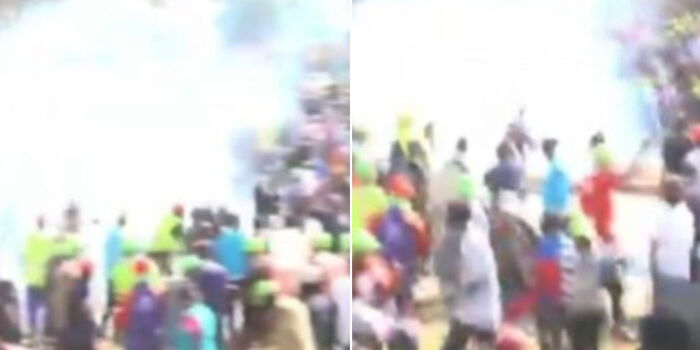
Panic as Police Fire Teargas at Gachagua Rally, Several Injured
Tension and fear gripped Kikuyu on Saturday after police fired teargas at a rally organised by Democracy for Citizens Party (DCP) leader Rigathi Gachagua, leaving several people injured as chaos broke out across the town.
The confrontation began as Gachagua attempted to address a large group of young supporters who had gathered to hear him speak, but the event quickly turned volatile after police moved in to disperse the crowd.
Reports from the scene indicated that officers lobbed multiple teargas canisters, sparking panic and forcing supporters to run in different directions as clashes intensified.
The confusion worsened when an unidentified man allegedly stormed the rally carrying a sack full of bees, causing even more fear among those present. Witnesses said the strange incident triggered a stampede-like reaction as people scrambled for safety.
In the middle of the disorder, the man carrying the sack was reportedly seriously injured after he was stabbed during the commotion, adding another disturbing twist to an already tense political gathering.
Police officers also sealed off major roads leading into Kikuyu Town in an effort to control the swelling crowds and prevent more supporters from accessing the rally venue.
Despite the heavy police presence and the teargas smoke hanging over the area, Gachagua and his supporters remained at the scene, refusing to back down.
In dramatic scenes, the DCP leader was seen encouraging his supporters to stay calm and use water to ease the painful effects of the teargas.
Earlier in the day, anti-riot police had already engaged in running battles with sections of youth who had gathered in anticipation of the rally.
As tensions continued to rise, officers reportedly fired shots into the air to push back the increasingly defiant crowd just moments before Gachagua and other opposition leaders arrived.
The sound of gunfire and exploding teargas canisters sent many people fleeing, with several individuals reportedly trampled in the rush to escape.
Fears remained high that the number of injured people could rise as emergency responders and police struggled to restore calm in the busy town centre.
While addressing his supporters amid the chaos, Gachagua strongly condemned the violence and openly blamed Kimani Ichung’wah for what had happened.
He accused the Majority Leader of allegedly sending police officers and hired goons to disrupt the gathering and harm innocent residents.
According to Gachagua, it was deeply unfortunate that leaders would turn security agencies against the very people they are meant to serve, a claim that further escalated the political temperature surrounding the incident.
The unrest had reportedly started much earlier on Saturday morning, when movement along the Southern Bypass near Kikuyu was paralysed for hours after suspected goons blocked the road and began demanding money from motorists.
The roadblocks caused severe traffic snarl-ups, stranded travellers, and disrupted transport and business activities in the area.
Gachagua later linked the bypass disruption and the chaos in Kikuyu to what he described as a larger, state-backed operation involving organised gangs working closely with sections of the security agencies.
The former Deputy President went further to claim that goonism had now become deeply rooted in government operations, alleging that criminal gangs are increasingly being used to silence dissenting voices and intimidate political opponents.
He accused President William Ruto’s administration of normalising the use of such groups, saying they now allegedly work hand in hand with elements within the National Police Service to suppress opposition activities.
In one of his most controversial claims, Gachagua suggested that Kenya’s recent multinational police mission to Haiti may not have been solely about restoring peace in the Caribbean nation.
Instead, he alleged that the deployment may also have served as a learning ground for how informal groups can be incorporated into broader security operations.
The remarks are likely to spark fresh political debate, especially as the country continues to witness rising tensions between the government and opposition figures.
Overall, the chaotic scenes in Kikuyu painted the picture of a deeply polarised political atmosphere, where rallies are increasingly becoming flashpoints for confrontation, injuries, and bitter accusations between rival camps.
As investigations into the violence continue, many residents are now left questioning the growing pattern of unrest, the role of security agencies, and what it means for the future of political freedoms in the country.
Join TUKO KADI Official WhatsApp Channel to stay updated on time
https://whatsapp.com/channel/0029VaWT5gSGufImU8R0DO30
